

Document AI for Treuhand
Document AI for Treuhand mandates

Receipt OCR with booking suggestions
Spesenbelege, Quittungen and small-amount receipts arrive in every format imaginable. Two-pass Mistral OCR reads the text — even on creased thermal paper — and a JSON-mode extraction step returns vendor, date, gross, VAT and a suggested account. The junior accepts, edits or rejects in one screen.
Invoice ingest with VAT classification
Supplier invoices flow in as PDFs or scanned paper. The pipeline extracts header, line items, VAT rate per line and currency, then maps each line to the mandate's chart of accounts. Reverse-charge and mixed-rate Swiss invoices are handled per the mandate's VAT profile, not a generic template.
Bank statement reconciliation aid
For mandates whose bank feed is partial or missing, the pipeline parses bank statement PDFs and camt.053 attachments into line-level entries. The output is a reconciliation-ready file the senior can match against open items — the accounting tool stays in charge of the actual booking.
Supplier statement extraction
End-of-month supplier statements arrive as PDF tables that rarely match the mandate's open-items list one-to-one. We extract the supplier line items and flag discrepancies against the ledger so the Treuhand resolves them once, not invoice-by-invoice.
Payroll-doc handoff for monthly close
Pay-slips, AHV statements, expense reimbursements and Quellensteuer attachments are classified per employee and per period, then handed off in the structure the firm's payroll tool or the S001.4 Payroll & HR pipeline expects. Monthly close stops being a paper hunt.
Integration with Bexio, Abacus and Sage
We do not replace the accounting tool. We produce the import payload it already accepts — CSV in the Bexio/Abacus/Sage column convention, or via the accountant-facing API where one exists. The ledger of record stays where the Treuhand decided it lives.
How we deliver it
Discovery: mandate inventory and tool map
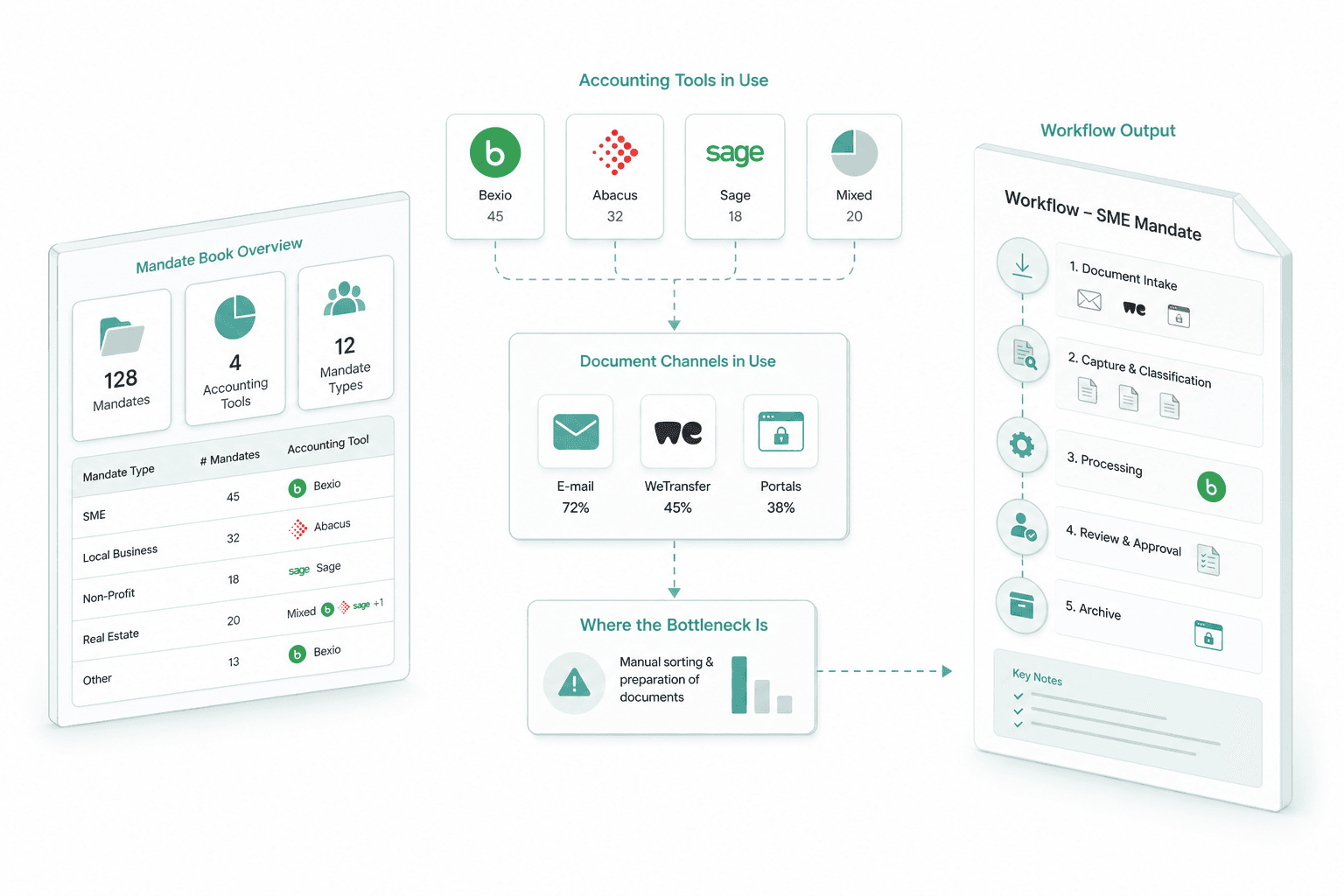
We walk through the firm's mandate book at the level the partner already runs it: how many mandates, which accounting tool per mandate (Bexio, Abacus, Sage, mixed), which document channels are in use today (e-mail, WeTransfer, portals), and where the bottleneck actually sits. The output is a one-page workflow per representative mandate type.
Pilot: one mandate, one document family
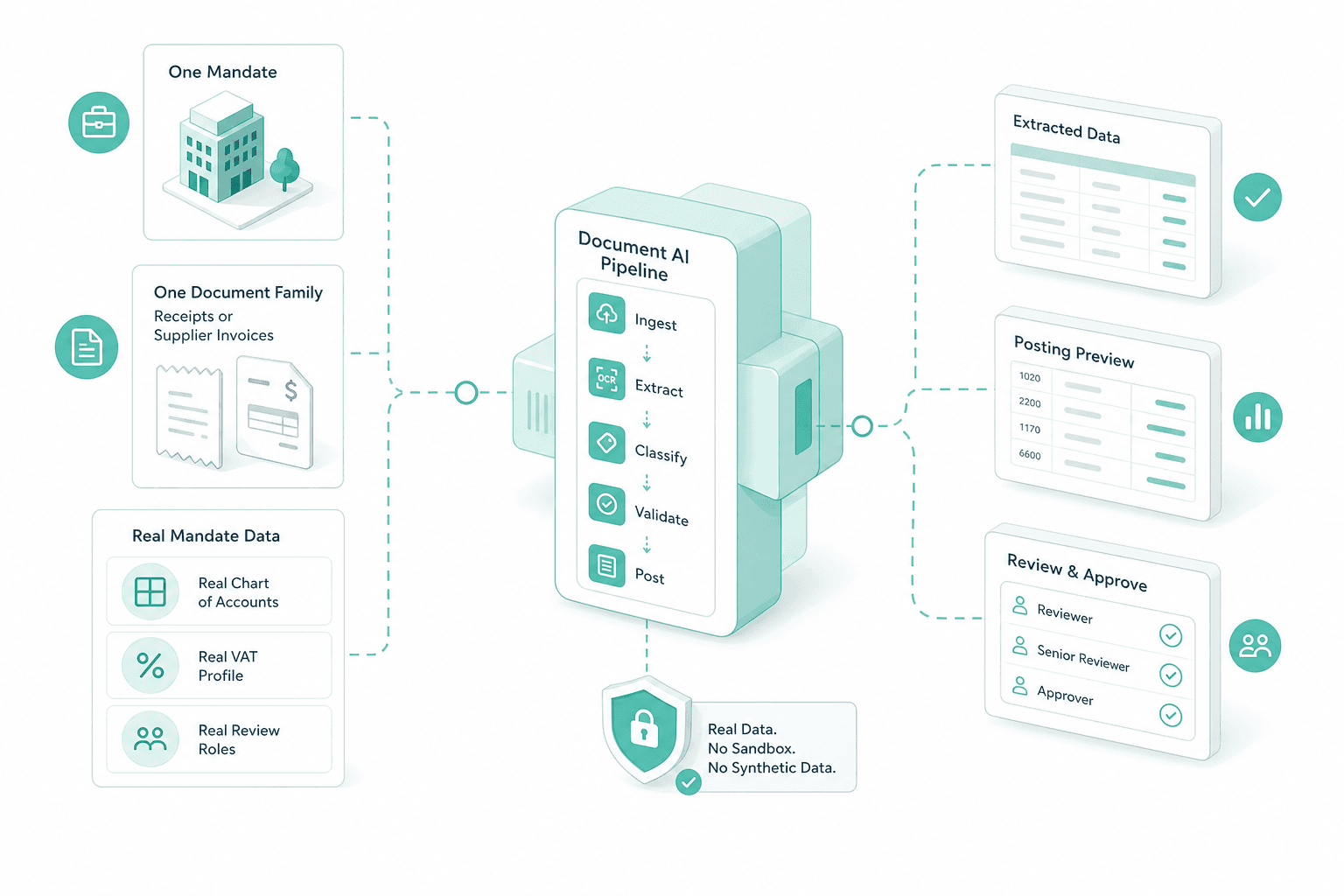
We pick one live mandate and one document family — usually receipts or supplier invoices — and put them through the pipeline end-to-end. The mandate's real chart of accounts, real VAT profile and real review roles. No sandbox, no synthetic data.
HITL with the Treuhand role model
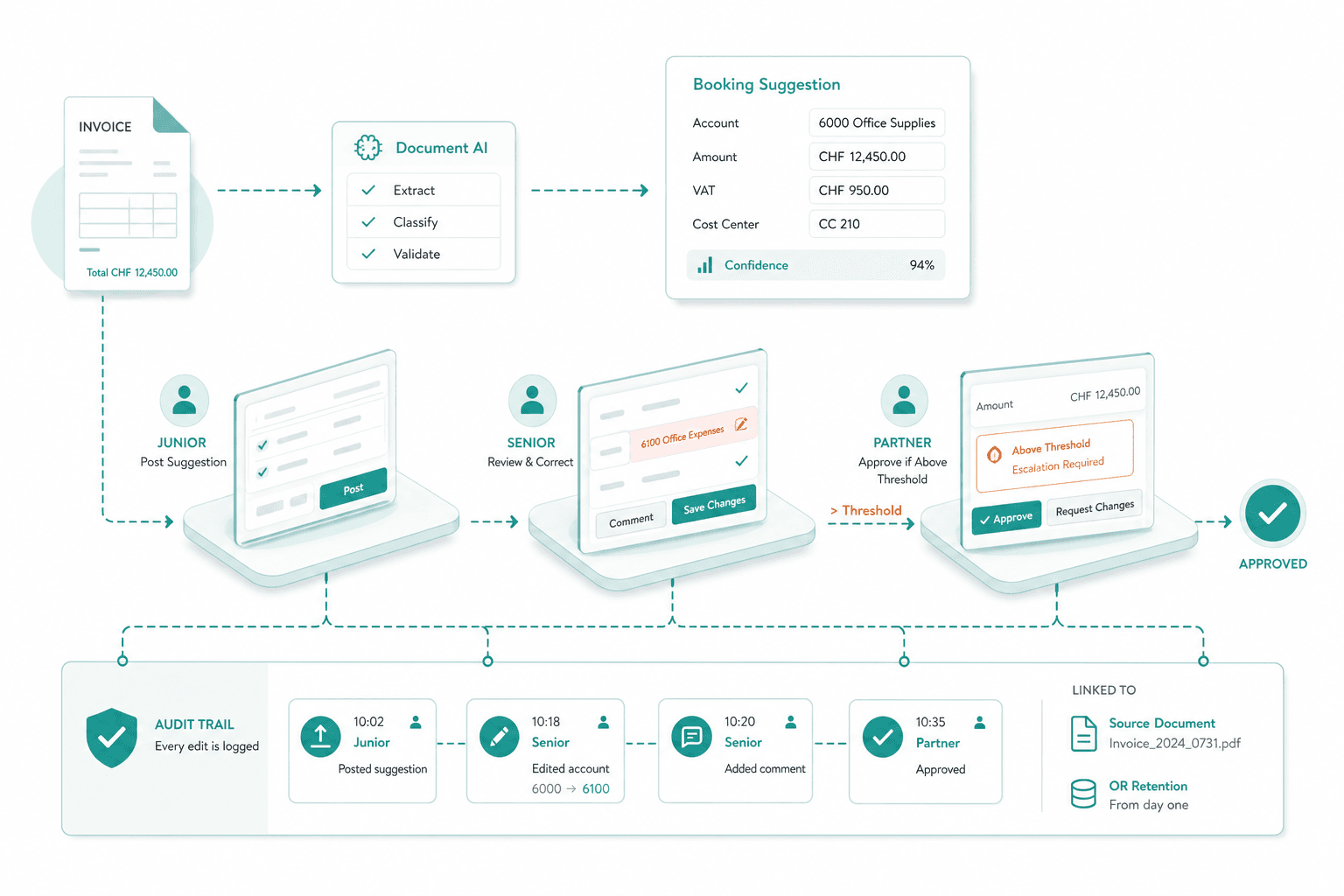
Review is bound to the way the firm already works: junior posts the booking suggestion, senior reviews and corrects, partner approves anything above an escalation threshold. Every edit is logged against the user and the source document, so the audit trail follows OR-style retention from day one.
Scale to the full mandate portfolio
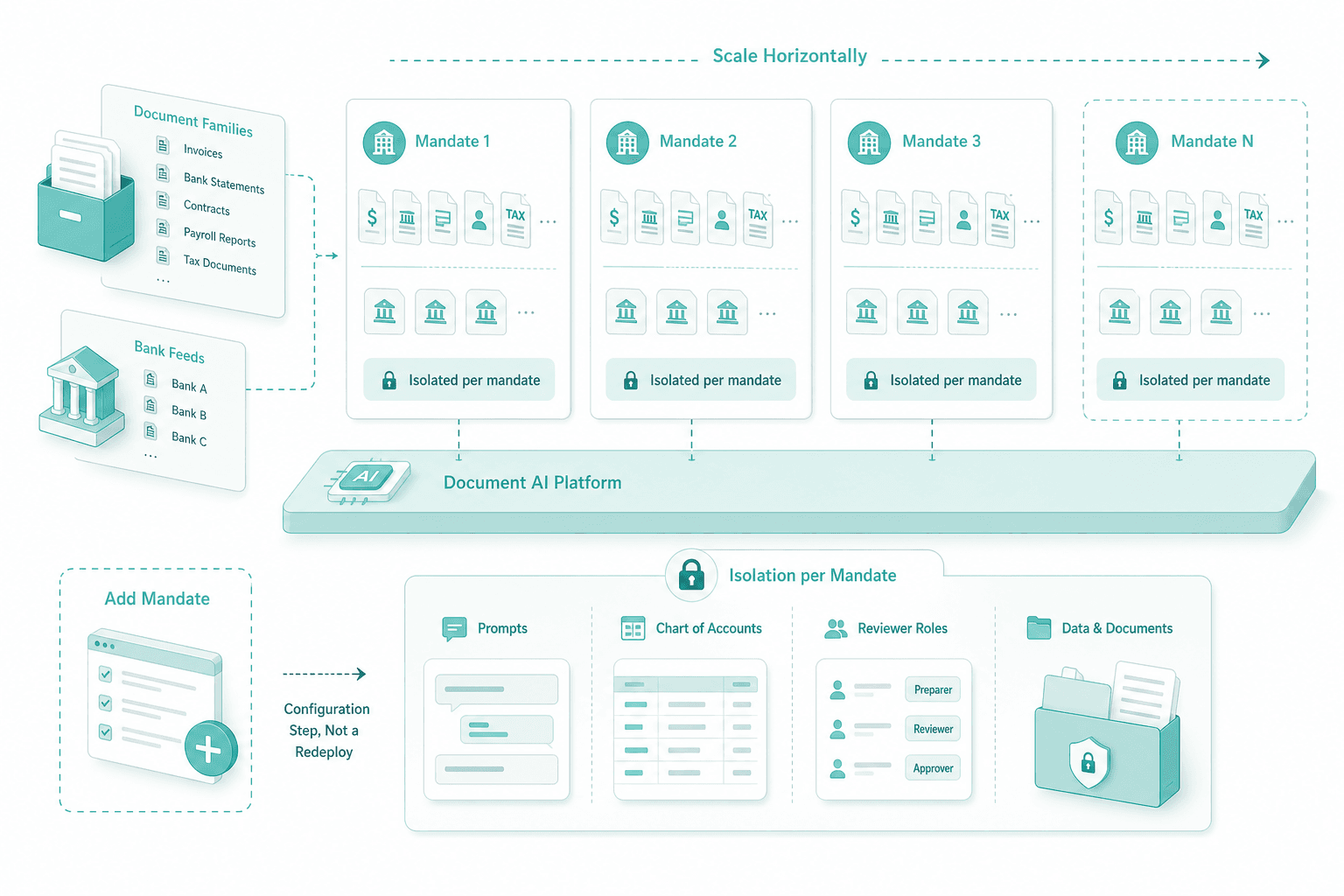
Once one mandate is stable, we extend horizontally — more mandates, more document families, more bank feeds. Per-mandate isolation means each client's prompts, chart of accounts and reviewer roles stay scoped to that mandate. Adding a mandate is a configuration step, not a redeploy.
We walk through the firm's mandate book at the level the partner already runs it: how many mandates, which accounting tool per mandate (Bexio, Abacus, Sage, mixed), which document channels are in use today (e-mail, WeTransfer, portals), and where the bottleneck actually sits. The output is a one-page workflow per representative mandate type.
We pick one live mandate and one document family — usually receipts or supplier invoices — and put them through the pipeline end-to-end. The mandate's real chart of accounts, real VAT profile and real review roles. No sandbox, no synthetic data.
Review is bound to the way the firm already works: junior posts the booking suggestion, senior reviews and corrects, partner approves anything above an escalation threshold. Every edit is logged against the user and the source document, so the audit trail follows OR-style retention from day one.
Once one mandate is stable, we extend horizontally — more mandates, more document families, more bank feeds. Per-mandate isolation means each client's prompts, chart of accounts and reviewer roles stay scoped to that mandate. Adding a mandate is a configuration step, not a redeploy.
Selected engagements
SWISS INSURANCE POC
Insurance Document Automation POC for a Swiss Back Office

How SAPIENTROQ built a schema-driven insurance document automation POC for a Swiss back office: Mistral OCR plus OpenAI JSON-mode extraction, schemas generated live from admin-defined categories, with provider-swappable AI behind a single interface.
View Case
Why this fits Swiss Treuhand workflow, not a generic OCR tool
A layer on top of Bexio, Abacus and Sage — not a replacement
The accounting tool the firm picked years ago is where the ledger lives, where the closing reports are pulled, and where the auditor expects to log in. We do not touch that. The doc-AI layer absorbs the document workload upstream of the ledger and hands the booking-ready payload over the standard import surface — CSV in the conventions Bexio, Abacus or Sage already accept, or the accountant-facing API where one exists.
Per-mandate isolation, modelled on how the firm already thinks
Every Treuhand mandate has its own client, its own chart of accounts, its own VAT profile and its own confidentiality boundary. The pipeline mirrors that: each mandate is a logical workspace with its own document store, its own prompt configuration and its own reviewer roles. Documents and prompts do not cross mandates. The partner's view of the firm is the view of the system.
Role-scoped review: junior books, senior reviews, partner approves
Treuhand work has a quality gate, not a free-for-all. The review surface is built around three real roles. Junior accepts or corrects the booking suggestion; senior signs off the day's batch; the partner gets escalations and anything above a configurable threshold. Every edit is tied to user, document, prompt version and timestamp — the audit trail an OR-style 10-year retention regime expects, produced as a by-product of the workflow.
Swiss data residency and OR-conform retention
Mandate documents stay on Swiss-resident hosting (AWS Zurich) or on customer-premises servers where the firm prefers it. Retention is configured per mandate to match the Swiss Code of Obligations expectations for accounting documents; the legal sign-off on the retention policy stays with the Treuhand, where it belongs. Revised FADP and GDPR posture are deployment template, not bolt-on.
Frequently Asked Questions
No. The accounting tool the firm already runs stays the system of record. We sit upstream of it as a document AI layer — we ingest the receipts, invoices, bank statements and payroll documents, prepare the booking-ready payload, and hand it over the standard import surface the accounting tool accepts.
For Bexio, Abacus and Sage we produce the firm's existing import format — CSV in the column convention the tool already expects, or the accountant-facing API where one is exposed. No reverse-engineered private endpoints, no claimed partnership; the integration uses whatever surface the accounting tool itself documents for external imports.
Each mandate is a logical workspace with its own document store, chart of accounts, VAT profile, prompt configuration and reviewer roles. Documents and prompts do not cross mandates. A junior assigned to mandate A does not see mandate B's documents — the role binding sits on the editing surface, not on a separate ACL layer.
Three roles are wired in from day one. Junior accepts, edits or rejects the booking suggestion the model produced. Senior reviews and signs off the day's batch and resolves any flagged items. Partner gets anything above a configurable escalation threshold — unusual amounts, unclear VAT, missing source document — and final approval on closing periods.
Yes, on request. The default Swiss-resident deployment runs on AWS Zurich; customer-premises deployment is also available for firms with stricter sovereignty requirements. The on-premise Apertus track is the option to look at when the requirement is 'no public model endpoint touches the data'.
Retention is configured per mandate to align with Swiss Code of Obligations (Art. 957a / 958f) expectations for accounting document archiving. The technical retention mechanism is in place; the legal sign-off on the retention policy itself stays with the Treuhand, who carries the regulatory relationship with the mandate.
Mandate data is processed under a written processor agreement with the Treuhand as controller. Swiss residency is the default. Access is role-scoped, every read and edit is logged, and the audit trail follows the document for the lifetime of the mandate. Revised FADP and GDPR posture are part of the deployment template.
If the firm wants a client-facing portal, the client uploads documents and sees status — received, in review, posted. They never see other clients of the firm and never see the firm's internal review actions, prompts or reviewer comments. If the firm prefers to keep ingestion fully internal, the client channel can remain plain e-mail and the pipeline picks up from there.
About SAPIENTROQ


Interested in a solution?
We are glad to show you various options without any obligation.

Roland Kurmann
CEO, SAPIENTROQ

