

Digital HR Personnel File
What the digital personnel file does

Structured file per employee
Every employee has one electronic personnel file with a typed structure — master data, contract, addenda, payroll attachments, performance documents, leave, certificates, exit. Not a flat folder, but an HR file system where each section has its own fields, rules and retention.
Role-scoped access for real Swiss org-charts
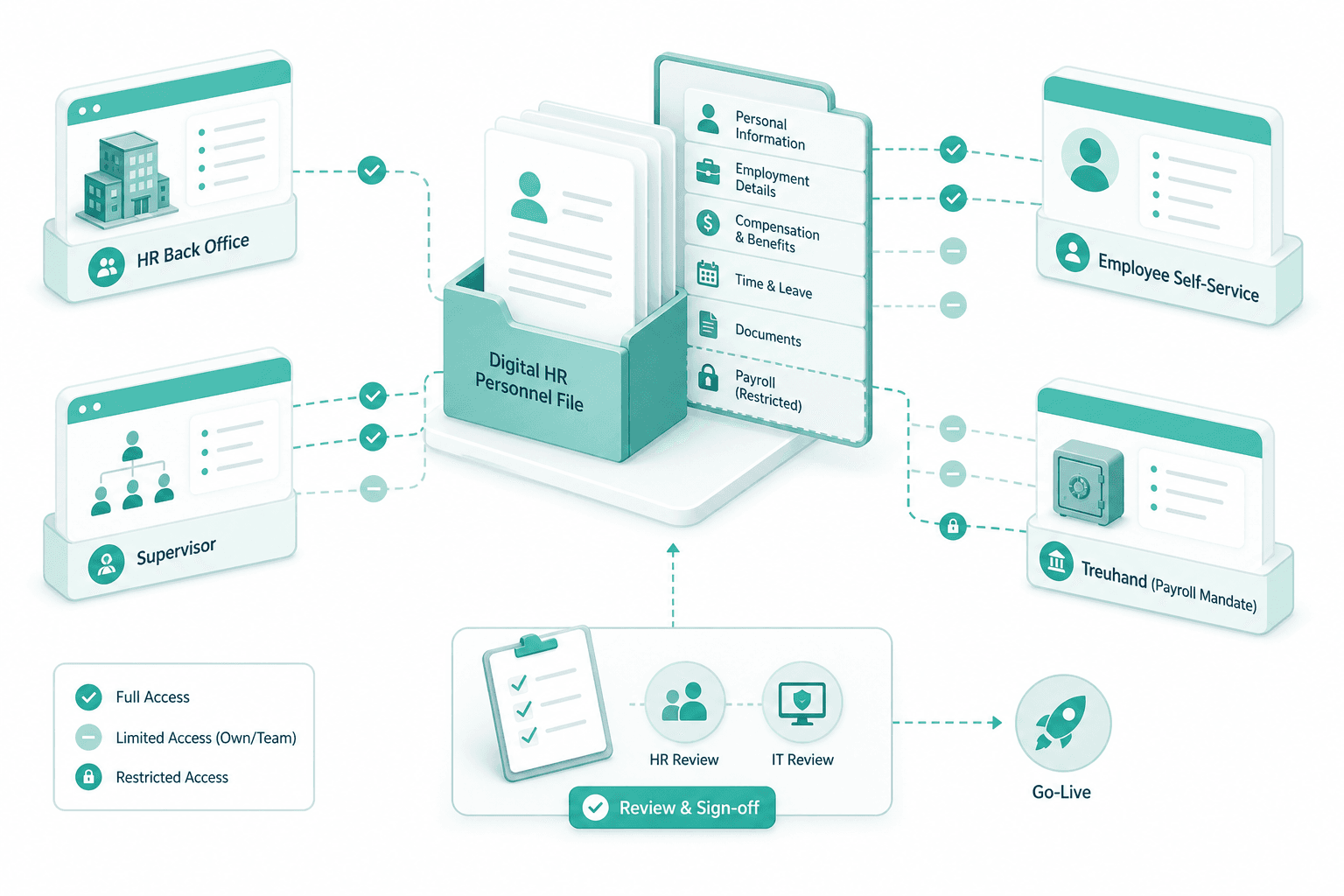
HR back office, supervisor, employee self-service and external Treuhand mandate are distinct roles. A supervisor sees performance and absence for their team only. The employee sees their own contract and payslips. The Treuhand partner sees only the payroll-relevant subset. Access is bound to the file model, not bolted on with ACLs.
Hire-to-leave lifecycle automation
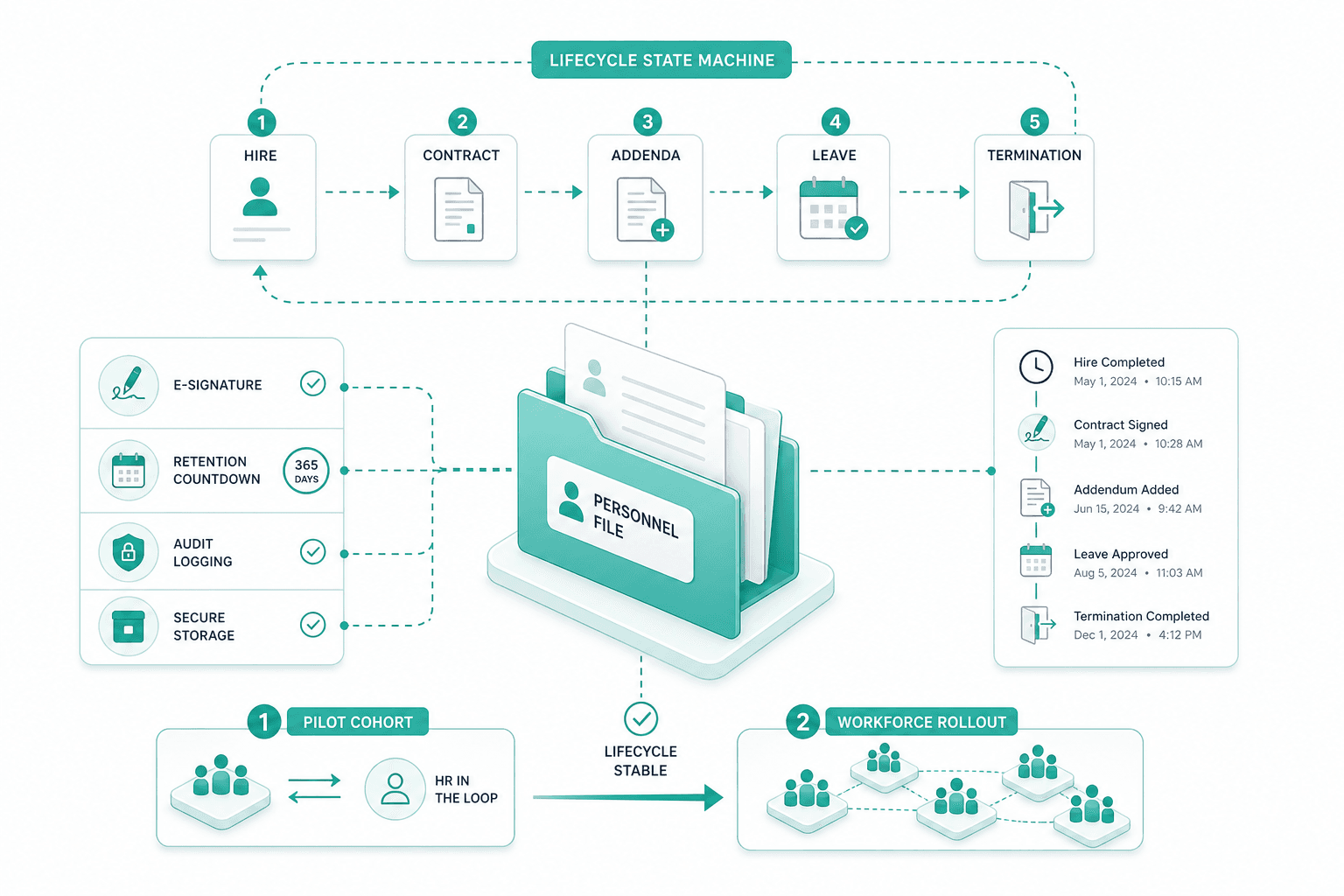
Onboarding pulls together the contract, work permit, social-security registration and starter documents into the new file. Mid-tenure events — addenda, role changes, salary letters — extend the file. Termination triggers the exit checklist, final payroll attachments and retention countdown. The lifecycle is a state machine, not a checklist in someone's inbox.
Audit trail and OR-compliant retention
Every view, edit, download and signature is logged at field and document level. Retention rules are configured per document type and aligned with Swiss OR Art. 957a / Art. 962, including the ten-year retention for relevant financial and contractual records. Deletion happens by policy, not by accident.
E-signature on contracts and addenda
SwissID and Skribble are integrated into the lifecycle. New contracts, addenda, salary letters and termination agreements are signed inside the file, with the signed PDF and audit certificate stored against the correct lifecycle step. No more chasing PDFs across email.
Search and retrieval that HR actually uses
Search by employee, period, document type, status, tag, signing party or retention status. Open the file, jump to the relevant document, see the version history. HR stops opening five tabs to answer one question about a 2019 contract addendum.
How we deliver it
Discovery: current cabinet and retention rules
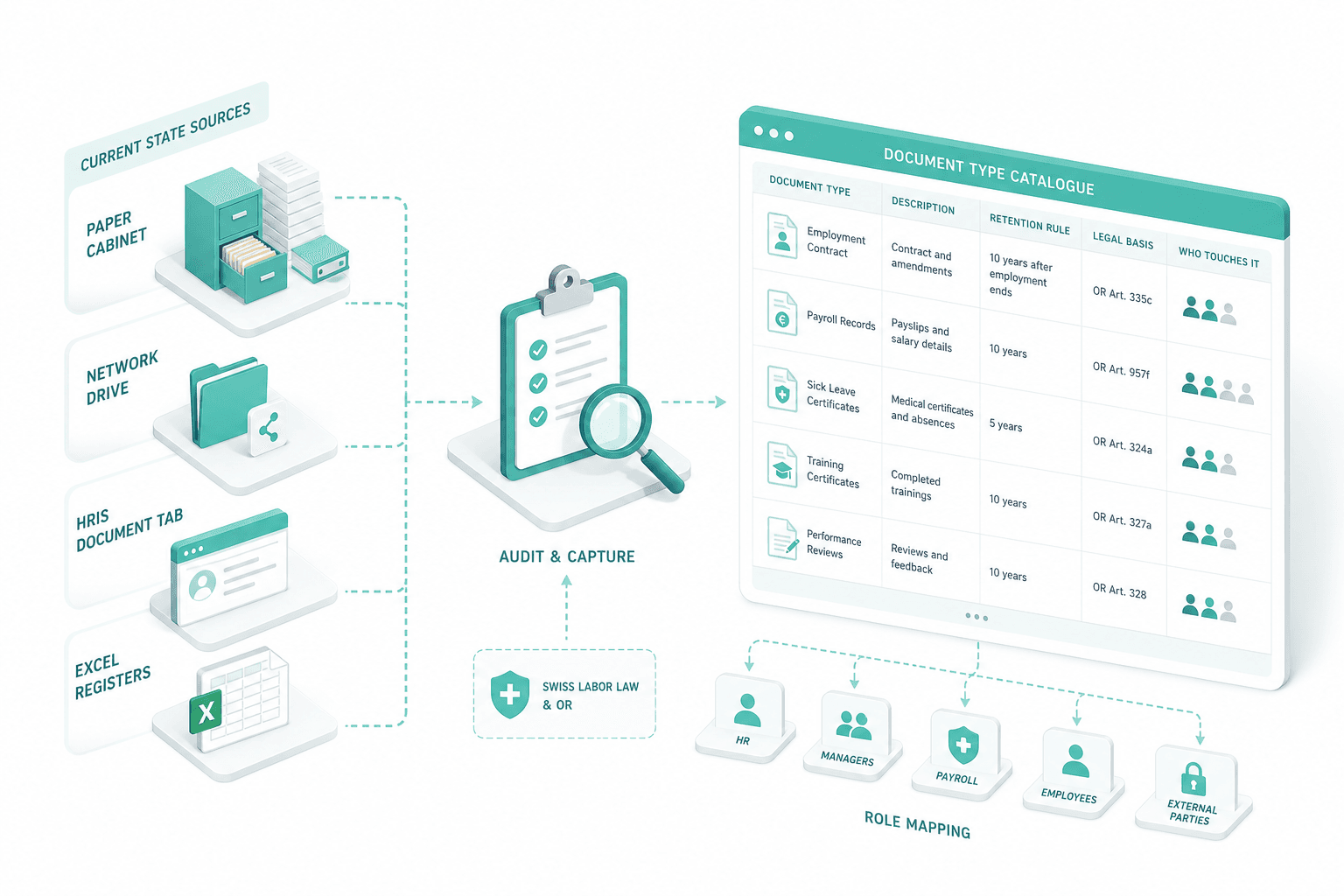
We audit the current state — paper cabinet, network drive, HRIS document tab, shadow Excel registers — and capture which document types exist, who touches them and which retention rule applies under Swiss labor law and the OR. The output is one document-type catalogue with retention and role mapping.
Migration from paper and network drives
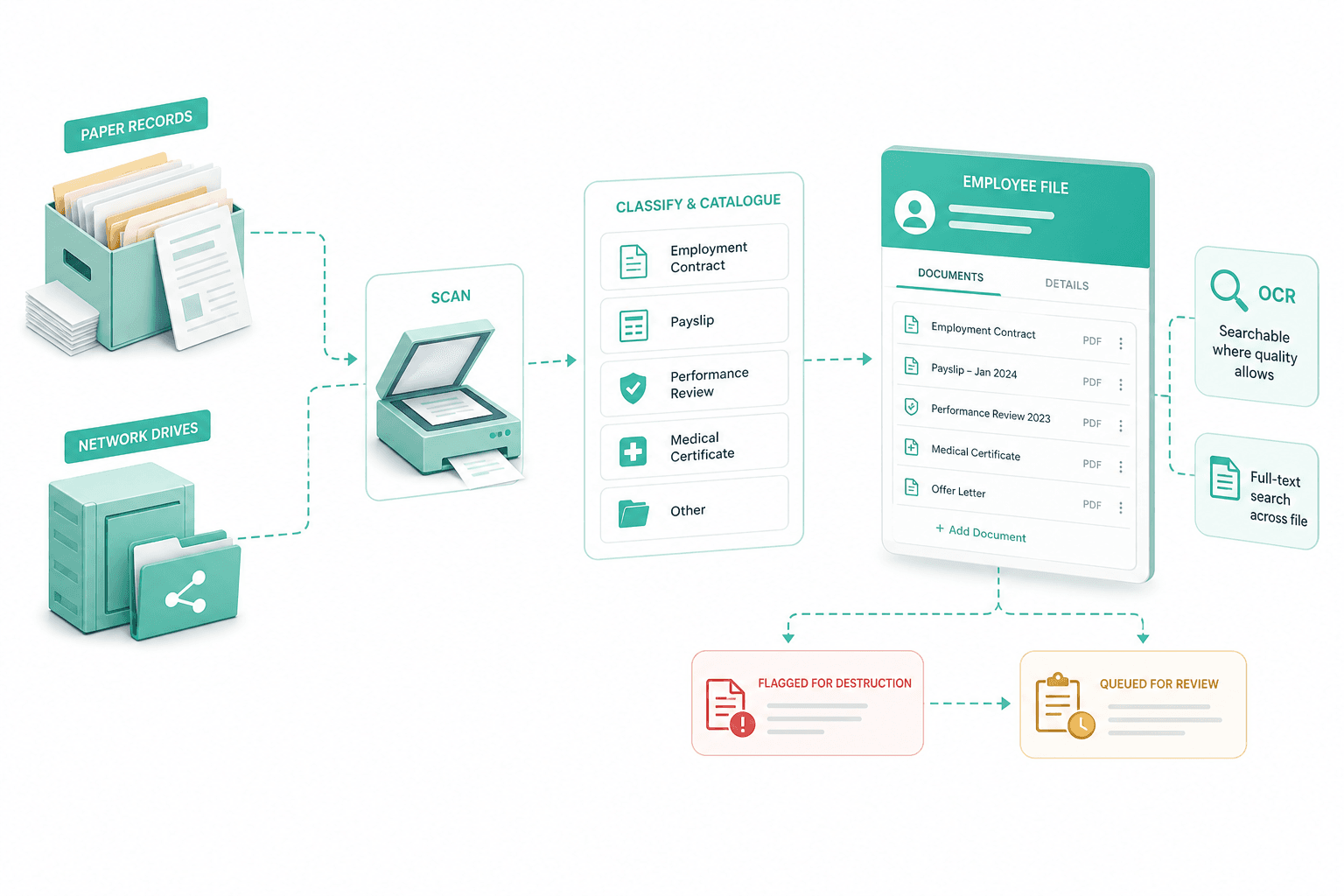
Existing personnel records are scanned, classified into the document-type catalogue and attached to the right employee file. Where paper quality allows, OCR is run so the historical file is searchable. Records flagged for destruction under retention policy are queued for review, not silently deleted.
Role and access model setup
We model HR back office, supervisor, employee self-service and Treuhand mandate as roles bound to the file structure. Supervisors see their team, employees see their own file, Treuhand sees only payroll-relevant sections. The model is reviewed with HR and IT before go-live.
Lifecycle automation rollout
Hire, contract, addenda, leave and termination are wired as a state machine on top of the file. E-signature, retention countdown and audit logging follow each step. We run the first cohort with HR in the loop, then extend across the workforce once the lifecycle is stable.
We audit the current state — paper cabinet, network drive, HRIS document tab, shadow Excel registers — and capture which document types exist, who touches them and which retention rule applies under Swiss labor law and the OR. The output is one document-type catalogue with retention and role mapping.
Existing personnel records are scanned, classified into the document-type catalogue and attached to the right employee file. Where paper quality allows, OCR is run so the historical file is searchable. Records flagged for destruction under retention policy are queued for review, not silently deleted.
We model HR back office, supervisor, employee self-service and Treuhand mandate as roles bound to the file structure. Supervisors see their team, employees see their own file, Treuhand sees only payroll-relevant sections. The model is reviewed with HR and IT before go-live.
Hire, contract, addenda, leave and termination are wired as a state machine on top of the file. E-signature, retention countdown and audit logging follow each step. We run the first cohort with HR in the loop, then extend across the workforce once the lifecycle is stable.
Selected engagements
SWISS INSURANCE POC
Insurance Document Automation POC for a Swiss Back Office

How SAPIENTROQ built a schema-driven insurance document automation POC for a Swiss back office: Mistral OCR plus OpenAI JSON-mode extraction, schemas generated live from admin-defined categories, with provider-swappable AI behind a single interface.
View Case
Why a custom file model beats off-the-shelf HRIS
Off-the-shelf HRIS modules force the customer to fit the vendor
Most HRIS suites ship a generic document tab — a flat folder per employee, a fixed set of categories, retention rules baked to whichever country the vendor was built for. That works until a Swiss HR team needs to enforce OR Art. 957a retention on payroll-relevant records for ten years, separate Treuhand access on payroll documents from internal HR access on disciplinary letters, or attach a Skribble signature certificate to a specific addendum. The document tab cannot model that, so the work spills back into email, paper and Excel registers. A custom file model is built around the Swiss employee lifecycle, with the role-scoped access and retention rules that the org actually operates by — not the ones the HRIS vendor happened to ship.
Role-model that fits real Swiss org-charts
A Swiss mid-sized employer rarely runs HR alone. Payroll is often handled by a Treuhand partner who needs visibility on payroll-relevant documents and nothing else. Supervisors need to see absence, performance and time-off for their team without ever seeing salary letters. Employees need self-service access to their own contract, payslips and certificates. A custom role model treats Treuhand, supervisor, HR and employee as first-class roles bound to the file structure — not as a single 'HR user' bucket that the vendor's template forces everyone into. Access is a property of the file, audited at field level.
Swiss data residency and OR-compliant audit by construction
Personnel records are personal data under nFADP/DSG and contain documents that fall under OR retention rules. Hosting in CH or EU, with on-prem as an option, is part of the deployment template — not a paid add-on. The audit trail captures who viewed, who edited, who signed, from which device, against which lifecycle step. When auditors, labour inspectors or a future legal dispute ask who saw a 2019 salary letter, the answer is in the file, not in a forgotten log file. That is the difference between a generic document tab and a digital personnel file built for Swiss employers.
Frequently Asked Questions
Generic HRIS modules ship a fixed document model with limited control over retention rules, role-scoped access and lifecycle automation. We build the file model around your Swiss org-chart and document catalogue, with OR-compliant retention and Treuhand-vs-HR-vs-supervisor access as first-class concepts. The HRIS stays for master data and payroll; the digital personnel file owns the document surface.
Retention rules are configured per document type and aligned with Swiss OR Art. 957a / Art. 962, including the ten-year retention for relevant financial and contractual records. The system tracks the retention clock from the trigger date, locks documents against deletion until expiry and queues records for review at end-of-retention instead of silently deleting them.
Yes. New contracts, addenda, salary letters and termination agreements can be signed via SwissID or Skribble directly from the file. The signed PDF and the signature certificate are stored against the correct lifecycle step, so the audit trail and the signed document live together rather than in separate inboxes.
Treuhand is modelled as a distinct role, with access scoped to the payroll-relevant subset of each employee file — typically contract, salary letters, payroll attachments and social-security registration. They never see disciplinary letters, performance documents or absence records that belong to internal HR. The scope is part of the file model and reviewed before go-live.
Personnel records are treated as personal data under the Swiss nFADP/DSG and the EU GDPR. Data residency is in CH or EU, with on-prem available for sensitive customers. Each view, edit, download and signature is logged at field level. Data-subject access requests can be served by exporting the employee's own file directly from the system.
Yes. We scan paper records, run OCR where quality allows, classify documents into the agreed catalogue and attach them to the right employee file. Records that fall outside the retention policy are queued for HR review before destruction, not silently deleted. Existing network-drive folders are migrated with the same classification pass.
Yes. Employees see their own contract, addenda, payslips and certificates and can download them on demand. Supervisors see performance, absence and time-off for their team. Both roles are scoped at the file-model level, so they cannot reach documents outside their permission scope even if a link is shared.
A first-cohort rollout — discovery, document-type catalogue, role model, lifecycle automation and migration of one department — typically lands in eight to twelve weeks. Workforce-wide migration extends from there. A final timeline is committed after discovery, against your actual document volume and retention rules.
About SAPIENTROQ


Interested in a solution?
We are glad to show you various options without any obligation.

Roland Kurmann
CEO, SAPIENTROQ

