

Process Automation Software
Process Automation Engineering Suite

End-to-end workflow engineering
We build the full workflow on your stack — intake form, state machine, role-gated review surface, downstream system update. The output is a running process that replaces a chain of inbox handoffs, not a workflow diagram in a slide deck. Every step is logged so the audit trail ships with the engagement, not as a follow-up project.
State-machine driven workflows
Each process is modelled as an explicit state machine: initiation, processing, ready-for-review, downstream-role, finalised, plus explicit failure states. Transitions are the only way work moves forward, so nothing falls into an email thread. We have shipped this pattern in Swiss back-office operations and on BPMN code-generation engagements.
Role-gated review and approval
Who sees which fields and who can approve a transition is enforced in code, not in a wiki. Purchasing, finance, compliance and operations each see only the slice they own. Escalations route automatically when a step stalls past its SLA. The same role-gating model runs in our Swiss PIM and insurance claim deployments.
BPMN to working code
If a process is already documented in BPMN, we use it. Our team has built code-generation tooling that converts BPMN flowcharts into executable workflow scaffolds — state machine, role permissions, transition handlers. Engineers extend the generated code; the diagram stays the source of truth for the business side.
Document-AI inside the workflow
Where a process starts with an inbound document — supplier PDF, claim form, contract — we drop in our Mistral OCR plus OpenAI JSON-mode extraction pipeline as the first state. The structured payload flows into the workflow without a separate integration project. Process automation and document intake become one engagement.
Swiss data residency and audit
Workflows run on EU or Swiss-resident infrastructure, on customer premises when FINMA or MDR posture requires it. Every transition, approver and field change is logged at audit grade. For sovereign-LLM customers, the document-AI step routes through our Apertus track so content never leaves Swiss jurisdiction.
How we build it
Workflow discovery
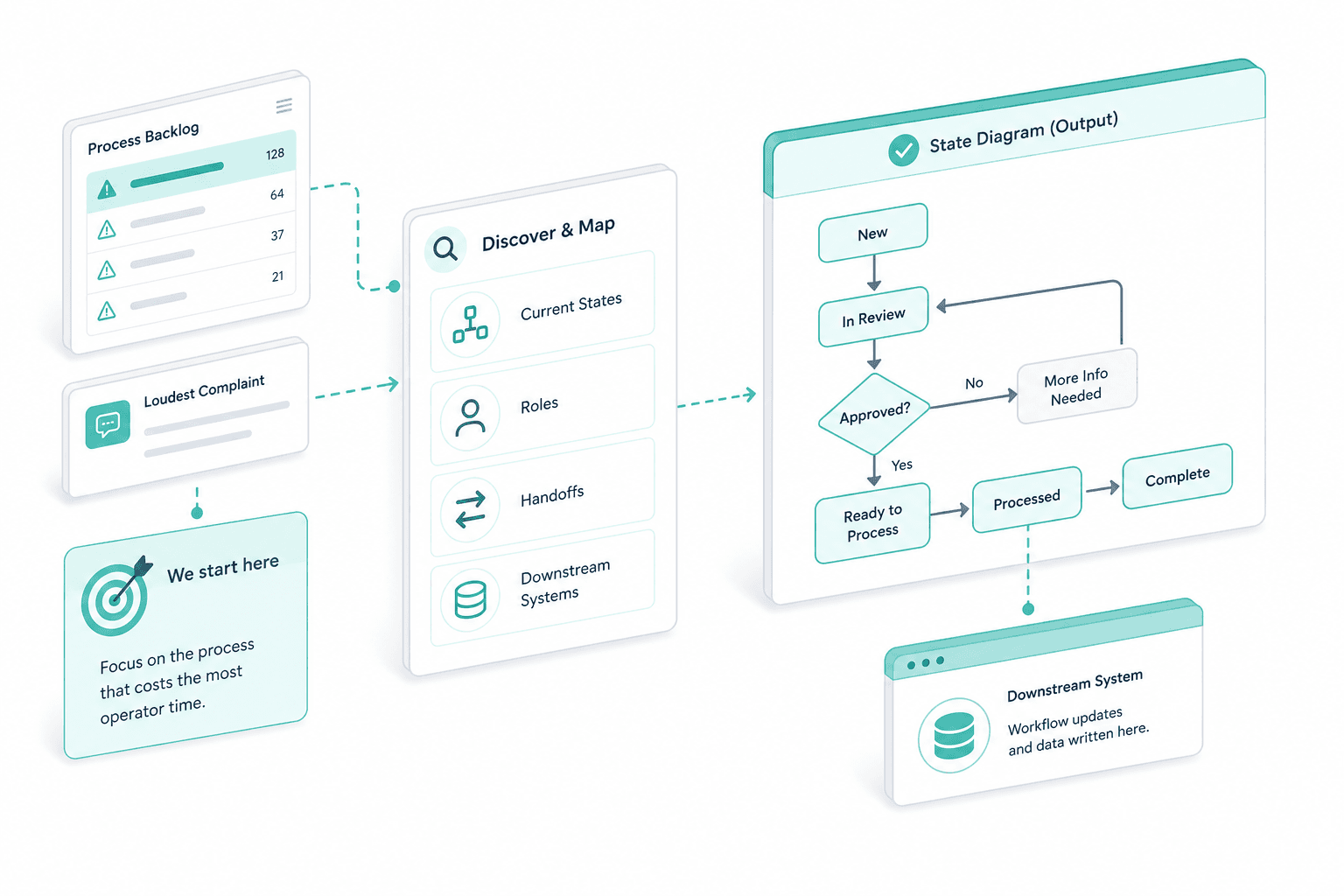
We start with the process that costs the most operator time today — the one with the biggest backlog or the loudest complaint. Together with operations we map current states, roles, handoffs and the downstream system that the workflow needs to update. The output is a state diagram, not a wishlist.
State-machine lock
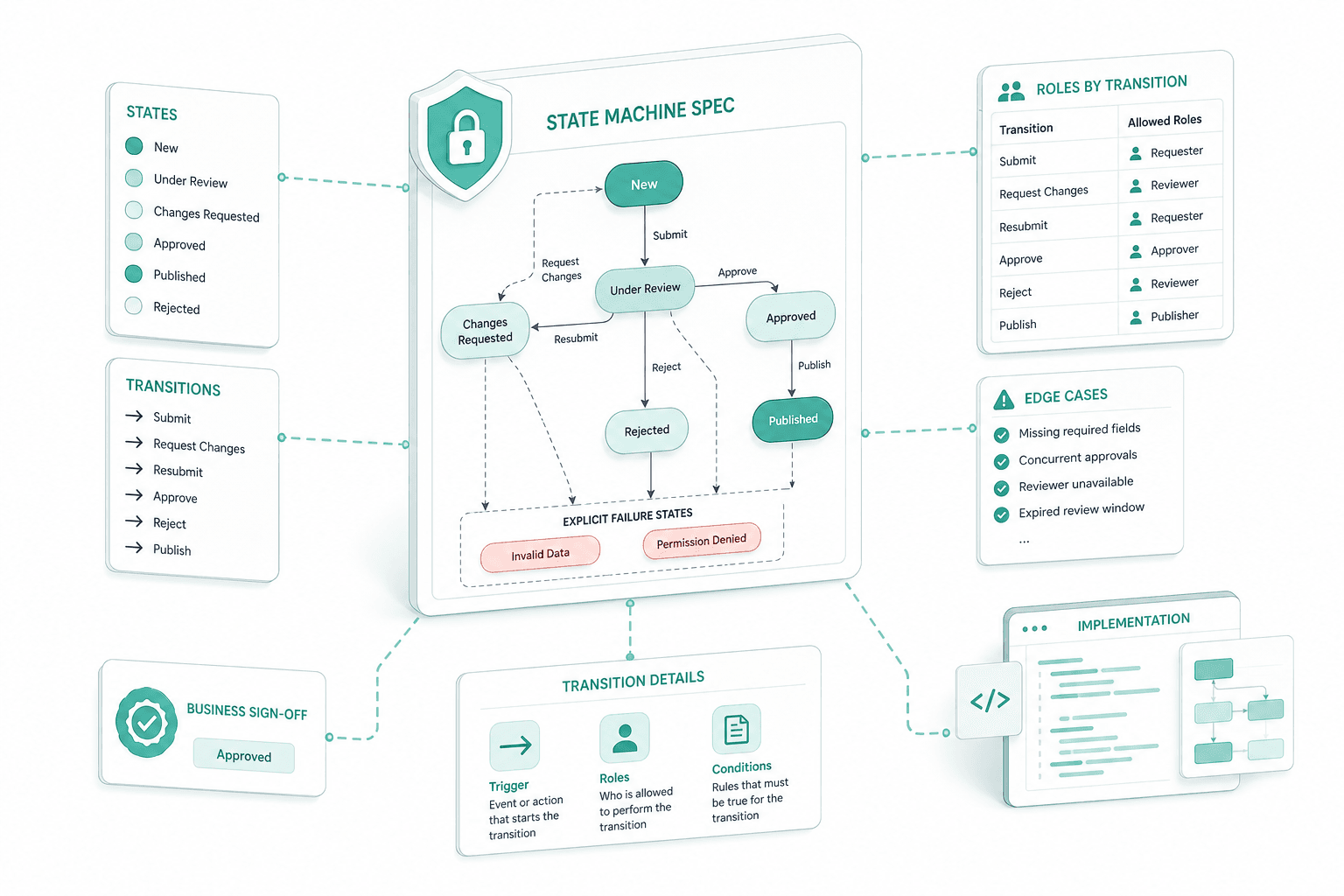
Before code, we lock the state machine — every state, every allowed transition, every role tied to each transition. Edge cases and explicit failure states are named upfront. This is the spec the team builds against, and the business side signs off on it before engineering starts.
Pilot workflow build
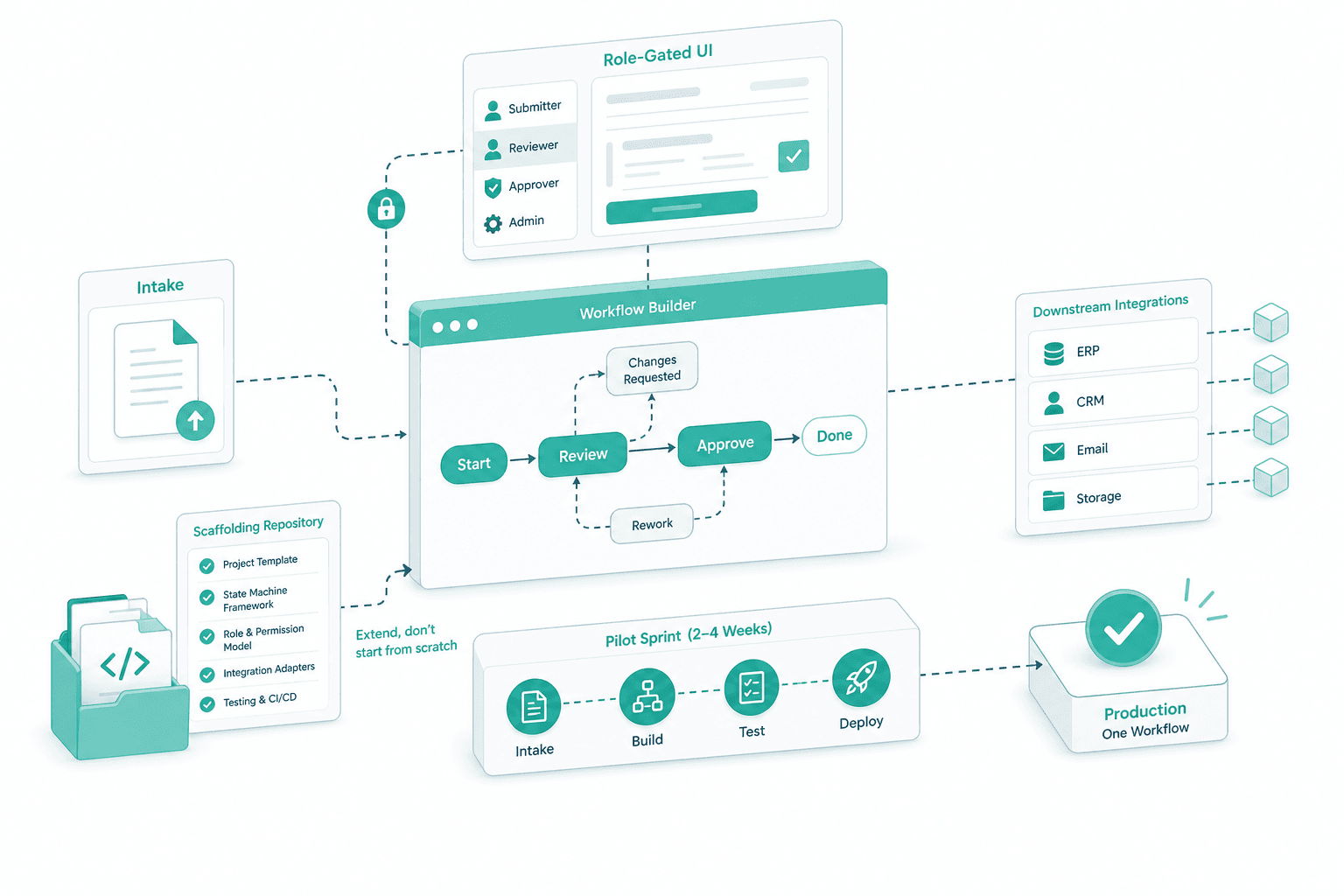
We build the first workflow end-to-end on your stack: intake, state machine, role-gated UI, downstream integration. Engineers extend the scaffolding rather than start from a blank repository. The pilot reaches production for one workflow within a defined sprint window, not a multi-quarter rollout.
Operator surface tuning
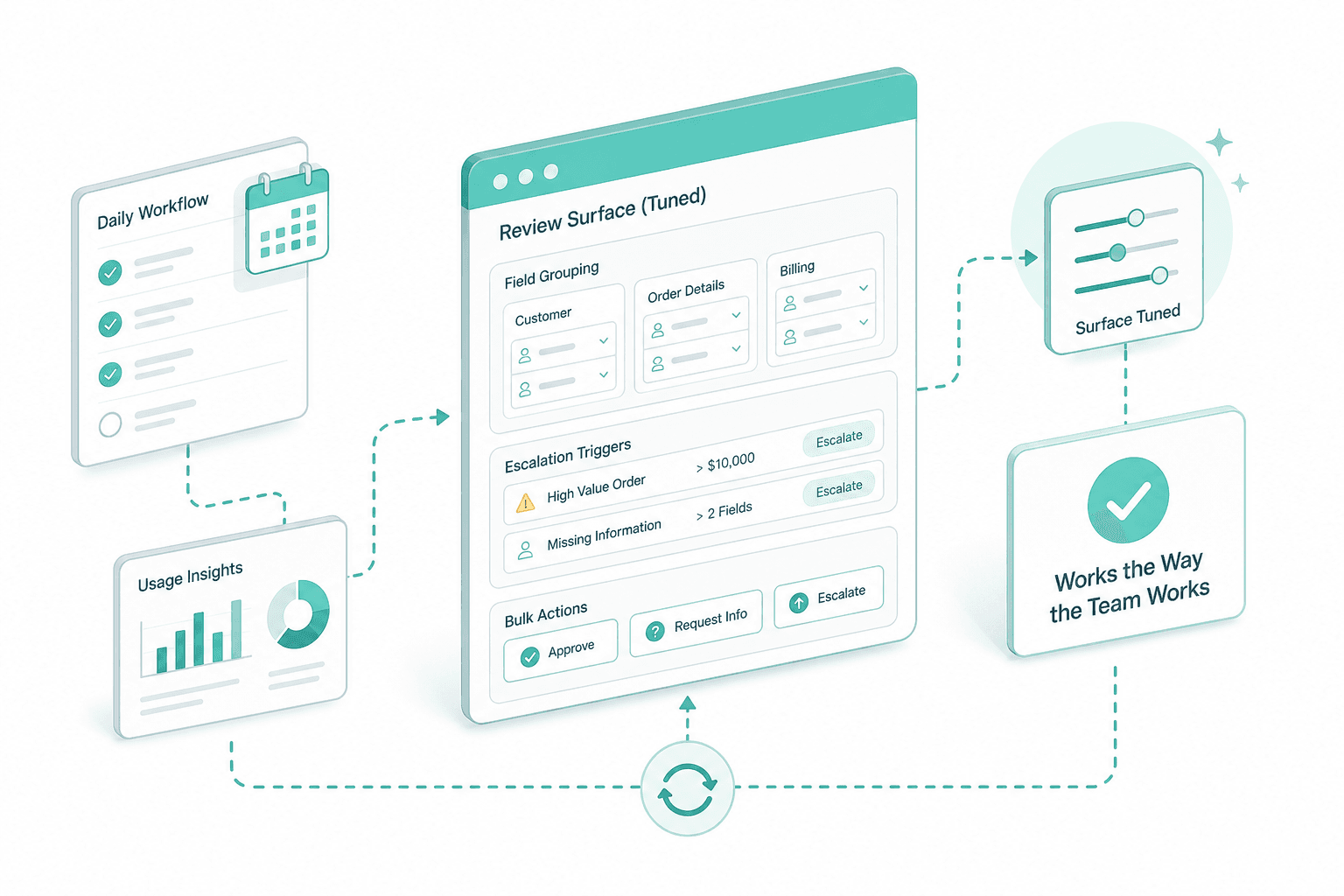
Once operators run the workflow daily we adjust the review surface — field grouping, escalation triggers, bulk actions — based on how the team actually works. This is where the workflow stops feeling like software and starts feeling like a tool the team owns.
Horizontal scale-out
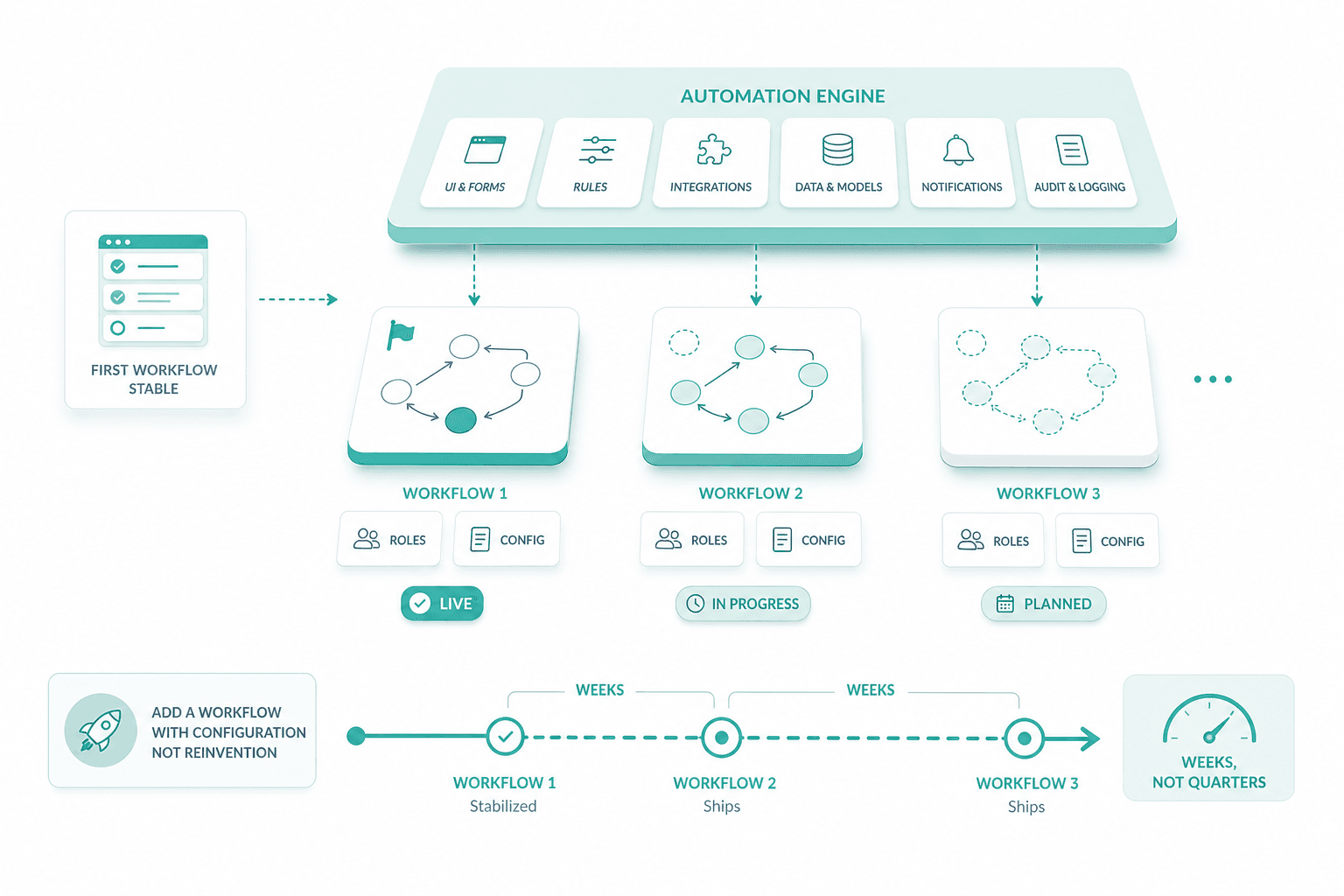
After the first workflow is stable we extend to the next process on the same engine — new state machine, new roles, same scaffolding. Adding a workflow becomes a configuration sprint rather than a from-scratch engagement, so the second and third workflows ship in weeks, not quarters.
Hand-off and support
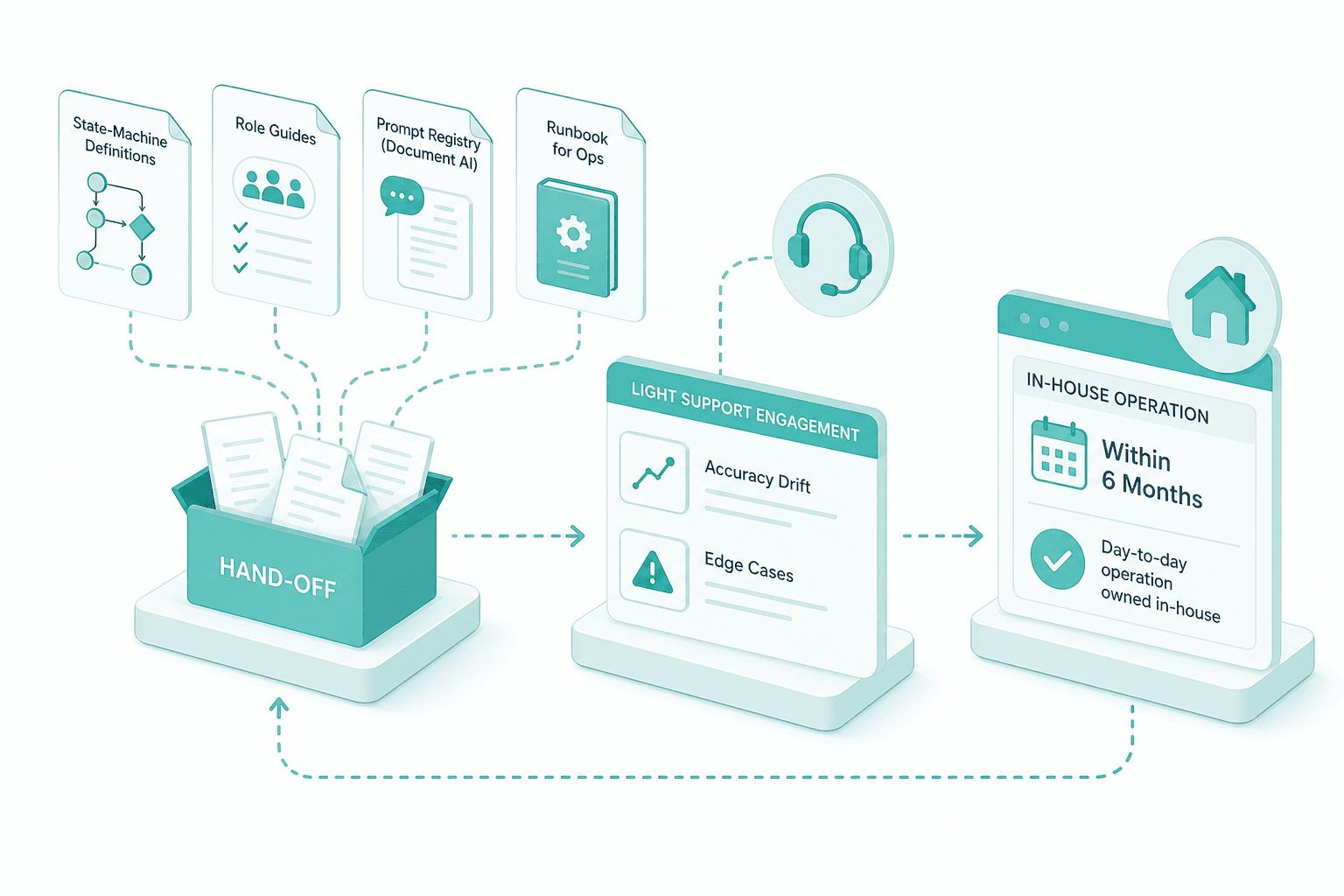
We hand over the state-machine definitions, role guides, prompt registry (where document AI is involved) and a runbook for ops. A light support engagement covers accuracy drift and edge cases. Most customers absorb day-to-day operation in-house within six months of go-live.
We start with the process that costs the most operator time today — the one with the biggest backlog or the loudest complaint. Together with operations we map current states, roles, handoffs and the downstream system that the workflow needs to update. The output is a state diagram, not a wishlist.
Before code, we lock the state machine — every state, every allowed transition, every role tied to each transition. Edge cases and explicit failure states are named upfront. This is the spec the team builds against, and the business side signs off on it before engineering starts.
We build the first workflow end-to-end on your stack: intake, state machine, role-gated UI, downstream integration. Engineers extend the scaffolding rather than start from a blank repository. The pilot reaches production for one workflow within a defined sprint window, not a multi-quarter rollout.
Once operators run the workflow daily we adjust the review surface — field grouping, escalation triggers, bulk actions — based on how the team actually works. This is where the workflow stops feeling like software and starts feeling like a tool the team owns.
After the first workflow is stable we extend to the next process on the same engine — new state machine, new roles, same scaffolding. Adding a workflow becomes a configuration sprint rather than a from-scratch engagement, so the second and third workflows ship in weeks, not quarters.
We hand over the state-machine definitions, role guides, prompt registry (where document AI is involved) and a runbook for ops. A light support engagement covers accuracy drift and edge cases. Most customers absorb day-to-day operation in-house within six months of go-live.
Selected engagements
WEITA AG
Weita Supplier Onboarding Workflow: Wholesale Digital Transformation

How SAPIENTROQ built a Laravel and Next.js workflow that turns PDFs, emails, images and spreadsheets into compliant PIM products for Weita AG, with Mistral OCR, OpenAI JSON-mode extraction and a database-backed prompt registry.
View Case
SANITAS TROESCH
PIM Implementation with HITL AI for Sanitas Troesch
How SAPIENTROQ delivered a PIM implementation with a multi-agent HITL pipeline that ingests 200k+ supplier SKUs from PDFs, Excel and Jira into the Sanitas Troesch PIM with audit-grade governance.
View Case
Why this engine, not generic automation
State machines, not happy-path scripts
Generic automation tools assume the happy path and break on the exceptions. Every workflow we ship is an explicit state machine — every transition, every failure state, every escalation is named upfront. When operations hits an edge case in month six, it is already a defined state with a defined owner.
Role gating in code, not in a wiki
Who can move a workflow from one state to the next is enforced server-side, not described in onboarding docs. Purchasing, finance, compliance and operations each see and edit only their slice. The same role-gating pattern runs in our Swiss PIM, insurance claim and lawyer-workflow deployments.
BPMN diagrams that actually execute
If your business side already maintains BPMN diagrams, we use them. Our code-generation tooling turns a BPMN flow into an executable workflow skeleton — state machine, role permissions, transition handlers. The diagram stays the spec, engineering extends the generated code, and the two stay in sync.
Document AI where the process starts with paper
Many workflows begin with an inbound document — claim, invoice, contract. We drop in Mistral OCR plus OpenAI JSON-mode extraction as the first state, so the workflow gets structured data on transition one. Process automation and document intake ship as one engagement, not two integrations.
Audit-grade by construction
Every transition, every approver, every field change is logged. The audit trail ships standard, not as a follow-up project. For FINMA, MDR and IVDR-sensitive customers, GDPR posture and Swiss data residency are part of the deployment template, including signed transition history.
Swiss delivery, not a US automation reseller
The team building your workflow is the same team that engineered Swiss PIM, claims, and lawyer-workflow platforms. EN and DE are baked into every operator surface; FR and IT extend without code changes. Same engineering discipline, three live verticals already in production.
Frequently Asked Questions
Back-office processes with multiple roles, explicit handoffs and a downstream system that needs to be updated — supplier onboarding, claim intake, contract review, product-data publishing. We focus on workflows where the bottleneck is coordination, not creativity, and where one wrong handoff costs hours per case.
Either way. If you already run Camunda or n8n we extend them with role-gated UI, document AI and downstream connectors. If you have nothing, we build a custom state-machine engine on your stack — Laravel, Node or .NET — so the workflow lives in the same codebase as the data. Both options are in production.
A single pilot workflow — discovery, state-machine lock, build, operator tuning — reaches production inside 8 to 12 weeks. Same engineering quality and same review surface as the full rollout. Subsequent workflows on the same engine ship in 3 to 6 weeks once the scaffolding is in place.
States, roles and field permissions are defined in an admin model so operations can extend an existing workflow — add a state, change an approver, retune an escalation — without a release. Adding a brand-new workflow is a configuration sprint of 1 to 2 weeks, not a from-scratch build.
If you maintain BPMN diagrams we feed them into our code generator, which produces a workflow skeleton — state machine, role permissions, transition handlers — that engineers then extend. The diagram stays the source of truth for the business side, and changes round-trip without manual rewrites. Pilot output ships in 2 to 4 weeks.
EU-hosted by default for GDPR. For FINMA, MDR or IVDR workloads we deploy on Swiss-resident servers, on-premises or on customer premises, and route any AI step through our Apertus sovereign-LLM track so document content never reaches public endpoints. Audit logs stay in-jurisdiction by default.
Every state has an SLA and an explicit failure state. When a step stalls past its SLA, the workflow auto-escalates to the next role or to a configured supervisor. Failed AI extractions route to a human-in-the-loop review queue. Nothing waits silently in an inbox; every exception has an owner and a deadline.
No. State-machine definitions, role models, integrations and (where used) the prompt registry transfer to your team along with a runbook. Most customers keep us on a thin support retainer for accuracy drift and edge cases; the workflow engine itself remains in your repository and your jurisdiction.
About SAPIENTROQ


Interested in a solution?
We are glad to show you various options without any obligation.

Roland Kurmann
CEO, SAPIENTROQ

