

FINMA-Grade Document Automation
Document AI for FINMA-supervised institutions

Claims document ingest
Schadenakten arrive as PDFs, scanned forms, e-mail bodies and image attachments — rarely in a single shape. Two-pass Mistral OCR turns each piece into structured text, the typed schema extracts the fields your claims system actually consumes, and the audit trail records every step. Claims handlers stop retyping and start reviewing.
KYC and AML packet automation
Onboarding packets — identification documents, beneficial-owner declarations, source-of-funds evidence, sanctions screening attachments — are classified against your KYC taxonomy and extracted into your onboarding system. Low-confidence fields and policy exceptions surface to the compliance officer queue, not to the front office.
Policy schedules and contract extraction
Policy schedules, endorsements, intermediary contracts and broker agreements are extracted against a typed schema — coverage limits, exclusions, signatories, effective dates — so the values flow into your policy administration or contract repository as data, not as PDF blobs.
Immutable audit trail
Every classification and extraction step is logged with the model ID, the prompt version, the reviewer and the timestamp. The audit log is append-only by design, exportable, and built to preserve the evidence your compliance team needs when internal audit or the regulator asks how a value reached the system of record.
Role-scoped HITL: handler, compliance, auditor
Claims handler, compliance officer and internal auditor are distinct roles wired into the editing surface — not a bolt-on ACL. The handler edits extraction output; the compliance officer reviews exceptions; the auditor reads the trail without write access. Separation of duties is part of the deployment template.
Intermediary and outsourcing documents
Broker contracts, agency agreements and supplier outsourcing paperwork — the documents that sit at the heart of FINMA-RS 18/3 outsourcing considerations — are extracted into a structured contract record. Renewal dates, sub-outsourcing clauses and material-service flags are surfaced for your operational risk owners.
How a FINMA-grade rollout actually runs
Regulatory document inventory
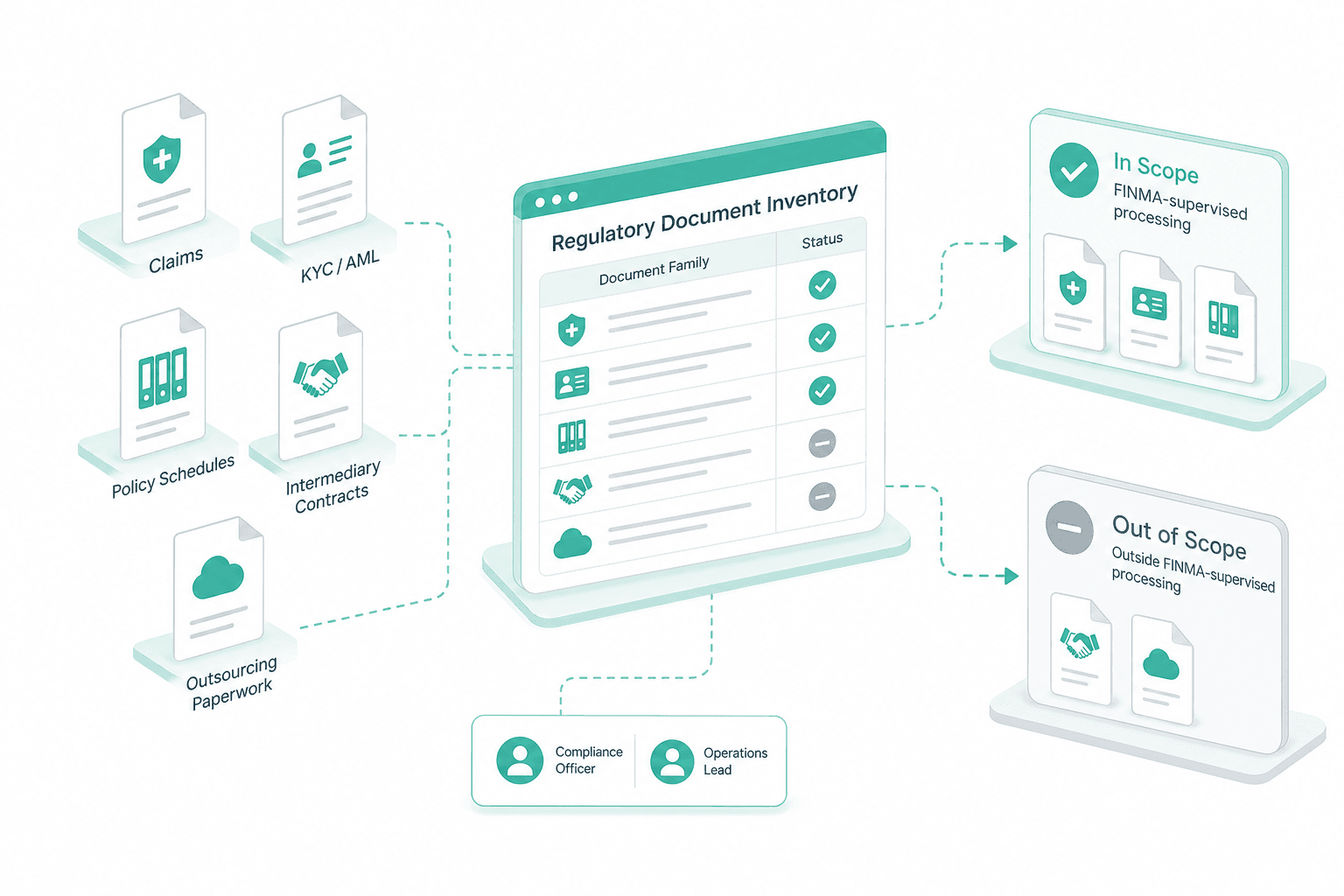
We sit down with your compliance officer and operations lead and map the document families actually in scope — claims, KYC/AML, policy schedules, intermediary contracts, outsourcing paperwork. We agree which families are in-scope for FINMA-supervised processing and which sit outside.
Pilot on one document family
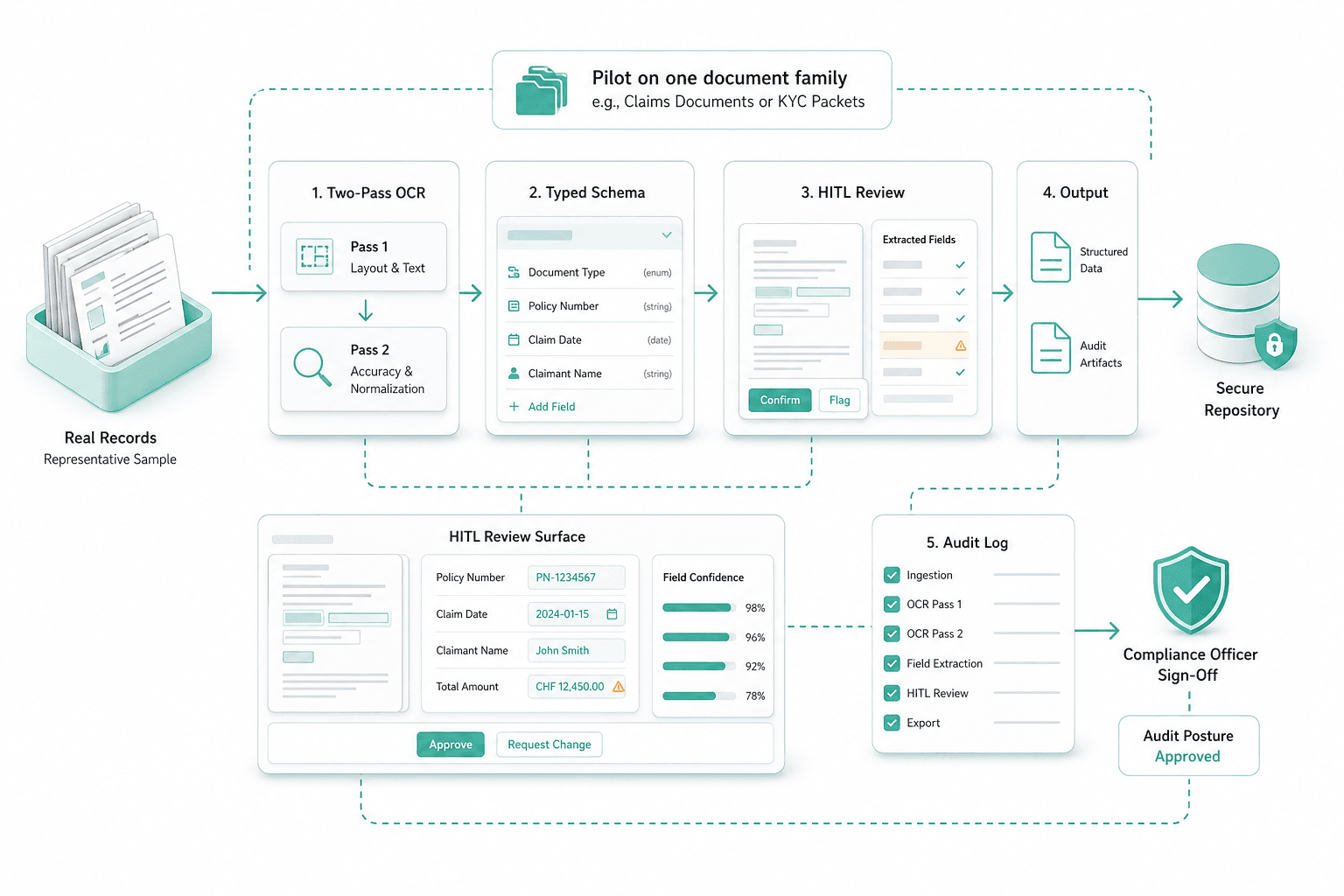
We run the full pipeline on one family — most often claims documents or KYC packets — against a representative sample of your real records. Two-pass OCR, typed schema, HITL surface, audit log. Your compliance officer signs off on the audit posture before we touch the next family.
HITL with FINMA-aligned audit trail
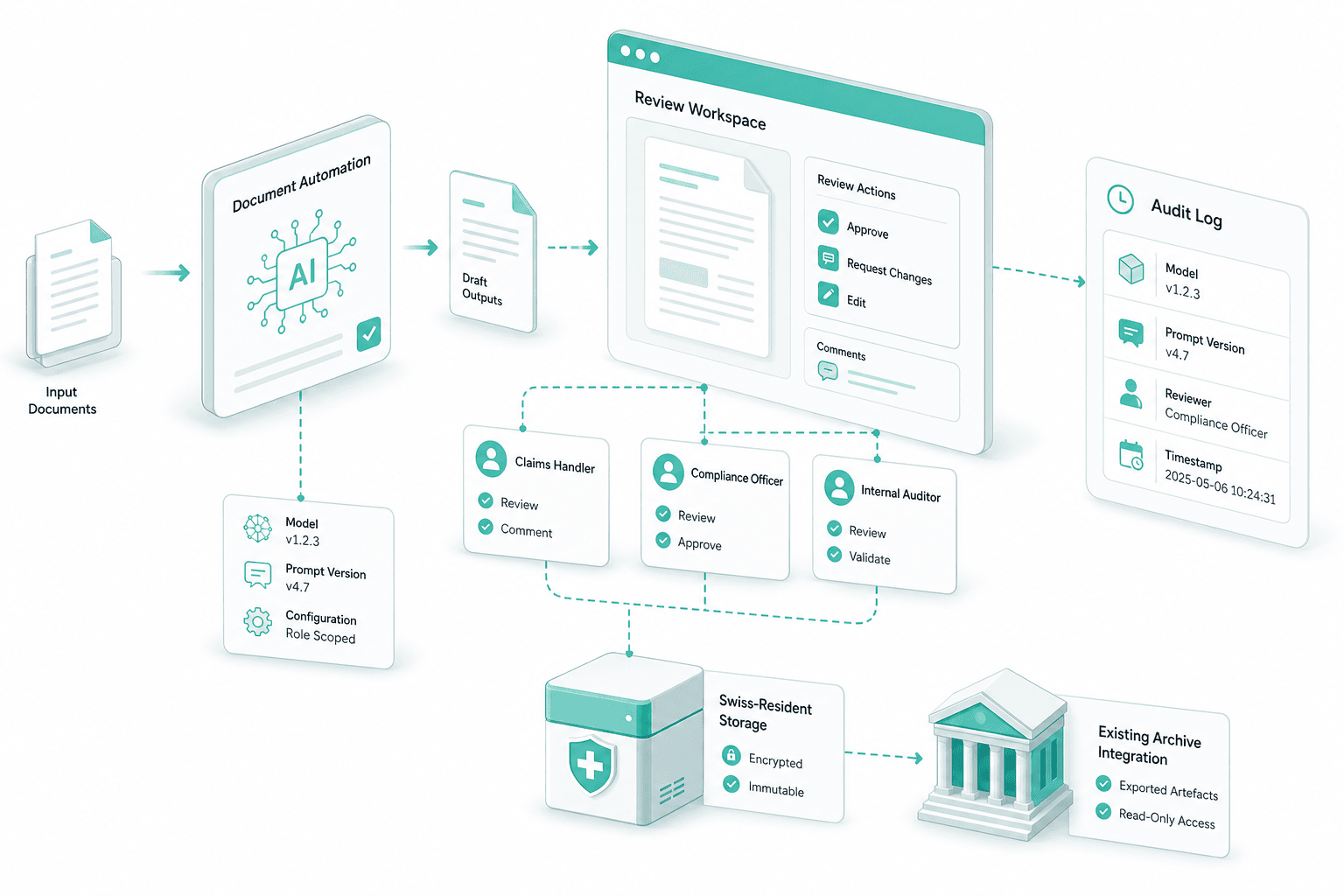
We wire the role-scoped review surface around your separation-of-duties model — claims handler, compliance officer, internal auditor. The audit log captures model, prompt version, reviewer and timestamp. The artefacts are persisted on Swiss-resident storage and exposed to your existing archive.
Scale to the full back-office
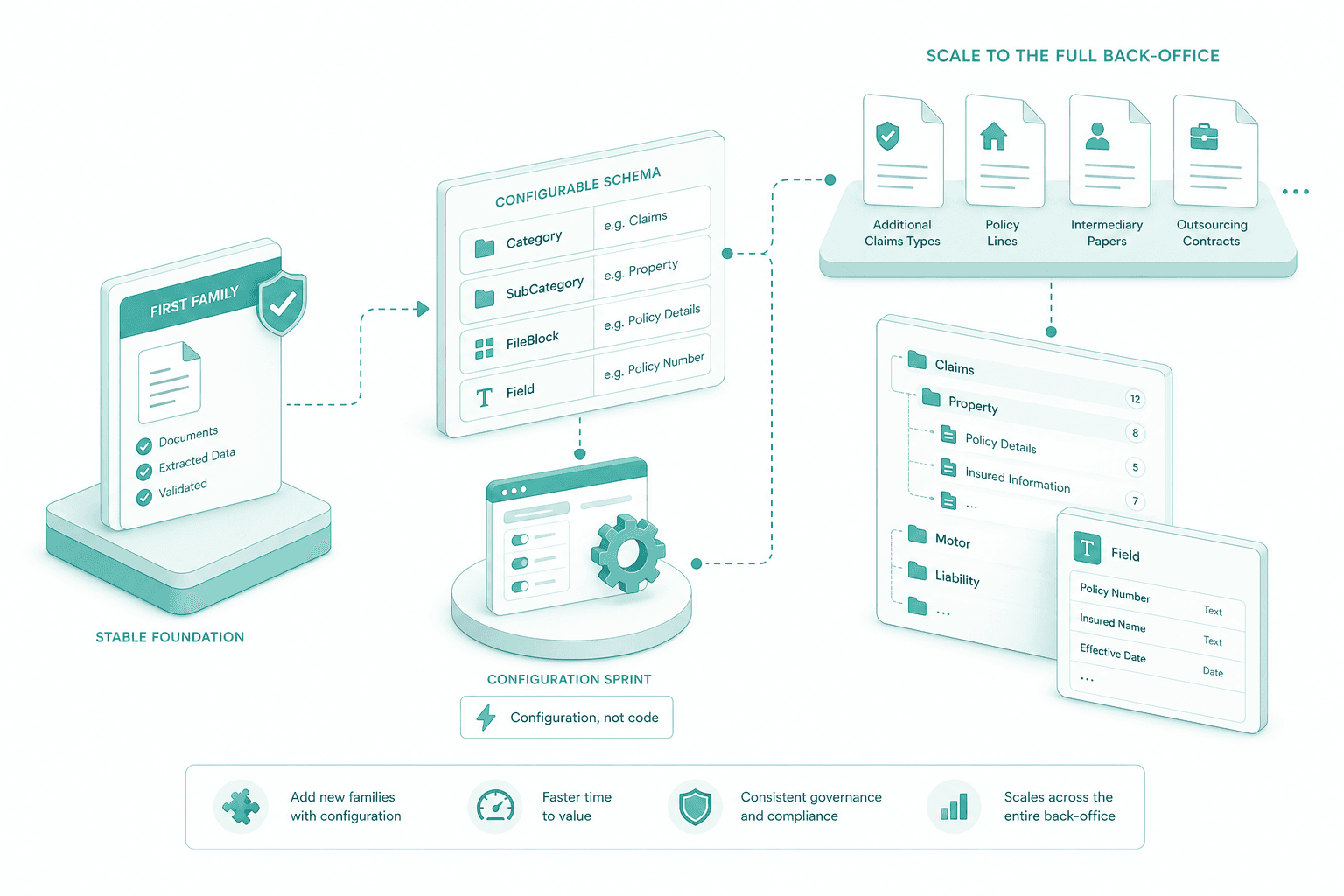
Once the first family is stable, we extend the taxonomy: additional claims types, policy lines, intermediary papers, outsourcing contracts. Because the Category / SubCategory / FileBlock / Field schema is configurable, each new family is a configuration sprint, not a code release.
We sit down with your compliance officer and operations lead and map the document families actually in scope — claims, KYC/AML, policy schedules, intermediary contracts, outsourcing paperwork. We agree which families are in-scope for FINMA-supervised processing and which sit outside.
We run the full pipeline on one family — most often claims documents or KYC packets — against a representative sample of your real records. Two-pass OCR, typed schema, HITL surface, audit log. Your compliance officer signs off on the audit posture before we touch the next family.
We wire the role-scoped review surface around your separation-of-duties model — claims handler, compliance officer, internal auditor. The audit log captures model, prompt version, reviewer and timestamp. The artefacts are persisted on Swiss-resident storage and exposed to your existing archive.
Once the first family is stable, we extend the taxonomy: additional claims types, policy lines, intermediary papers, outsourcing contracts. Because the Category / SubCategory / FileBlock / Field schema is configurable, each new family is a configuration sprint, not a code release.
Selected engagements
SWISS INSURANCE POC
Insurance Document Automation POC for a Swiss Back Office

How SAPIENTROQ built a schema-driven insurance document automation POC for a Swiss back office: Mistral OCR plus OpenAI JSON-mode extraction, schemas generated live from admin-defined categories, with provider-swappable AI behind a single interface.
View Case
Built for FINMA-supervised back-offices
Why an audit-grade engine for FINMA-supervised institutions
FINMA does not certify software, and we do not pretend otherwise. What we do build is the document automation evidence your compliance team needs when internal audit or the regulator asks how a value moved from a PDF into the system of record. Every classification and extraction decision is logged with model ID, prompt version, reviewer and timestamp. The log is append-only by construction, exportable, and persisted on Swiss-resident storage that fits OR-compliant archive expectations and the ten-year horizon Swiss bookkeeping rules carry. The engine supports your compliance team in preserving that evidence — it does not replace the compliance function.
Swiss data residency and a non-public model path
Document content stays inside Swiss or EU jurisdiction by default — AWS Zurich, EU regions, or on customer-premises deployment. For institutions whose risk posture does not allow routing document content to public model endpoints, the Apertus sovereign-LLM track keeps inference inside Swiss-hosted infrastructure end-to-end. Data residency, archive integration and retention horizon are part of the deployment template, not a procurement afterthought.
Separation of duties wired into the editing surface
Claims handler, compliance officer and internal auditor are distinct roles in the review surface, not three flags on the same user. The handler edits extraction output for routine documents. The compliance officer sees the exception queue and policy-flagged items. The internal auditor reads the trail end-to-end without write access. The role split is part of the deployment template — relevant to FINMA-RS 18/3 outsourcing considerations and FINMA-RS 23/1 operational-risk considerations alike, without claiming either circular is satisfied by the product alone.
Frequently Asked Questions
No. FINMA does not certify software and no vendor product alone makes an institution FINMA-compliant. Your compliance officer owns the regulatory posture. What the platform does is preserve the evidence your compliance team needs — immutable audit log, role separation of duties, Swiss data residency — so that the document-AI step in your process is auditable end-to-end.
Default deployment is EU-hosted with GDPR/nFADP posture. For FINMA-supervised workloads we deploy on AWS Zurich, on customer-premises, or on Swiss-resident infrastructure of your choosing. For institutions that cannot route document content to public LLM endpoints, the Apertus sovereign-LLM track keeps inference inside Swiss-hosted infrastructure end-to-end.
For every document and every classification or extraction decision: source file hash, model ID, prompt version, the typed schema applied, the extracted values, the reviewer who approved or amended each field, and the timestamp. The log is append-only by construction and exportable into your existing archive. It is designed to preserve evidence — not to replace your compliance team's own controls.
The engine writes extracted values into your claims management, policy administration or onboarding system through your existing API. We model the document workflow as a typed state machine with explicit failure states, so a stuck document never silently disappears from the audit trail. Three live production deployments today; integration patterns are catalogued, not improvised per customer.
Yes — identification documents, beneficial-owner declarations, source-of-funds evidence and sanctions-screening attachments are classified against your KYC taxonomy and extracted into your onboarding system. Low-confidence fields and policy exceptions surface to the compliance officer queue with role-scoped editing rights. The actual KYC and AML decision remains with your compliance function.
FINMA-RS 18/3 places explicit considerations on outsourcing of material services — risk assessment, contractual control, audit access, sub-outsourcing transparency, exit plan. We support your operational risk owners with a vendor pack covering deployment architecture, data residency, sub-processor list, audit access and exit handover documentation. The outsourcing decision and its risk assessment stay with your institution.
Extraction artefacts, source files and the immutable audit log can be persisted on Swiss-resident storage and exposed to your existing archive system. The retention horizon is configurable to the ten-year Swiss bookkeeping rule under the Code of Obligations, or to whatever longer horizon your internal policy or sector-specific guidance requires.
Yes. Category, SubCategory, FileBlock and Field are admin-configurable models. Operations and Compliance define a new family with its required fields, downstream system mapping and the reviewer role tied to it. Adding a new family for FINMA-relevant documents is configuration, not a code release.
About SAPIENTROQ


Interested in a solution?
We are glad to show you various options without any obligation.

Roland Kurmann
CEO, SAPIENTROQ

