

ERP & PIM Connectors, Swiss Stacks
ERP ↔ PIM Connector Suite

Typed attribute mappings
Every field crossing the boundary has a declared type, a source of truth and a coercion rule on the wire. SKU, EAN, pricing, stock, category, multilingual descriptions and asset references each move as typed bindings, not free-form CSV columns. The mapping file is the contract; the connector refuses any value that does not match it.
Two-way SKU, attribute, media sync
Product records, attribute changes, price and stock updates, image and document references flow in both directions. The PIM publishes enriched content downstream while the ERP pushes commercial reality upstream. Media syncs by reference with deterministic file naming, so the same asset never lands twice under different identifiers.
Conflict resolution rules
When both sides change the same SKU between syncs, the connector does not pick the last writer. Ownership is declared attribute by attribute — ERP owns price and stock, PIM owns descriptions and media, marketing owns campaigns — and the resolver applies that contract. Unresolved cases route to a HITL queue with both versions and the diff.
Delta sync vs full refresh
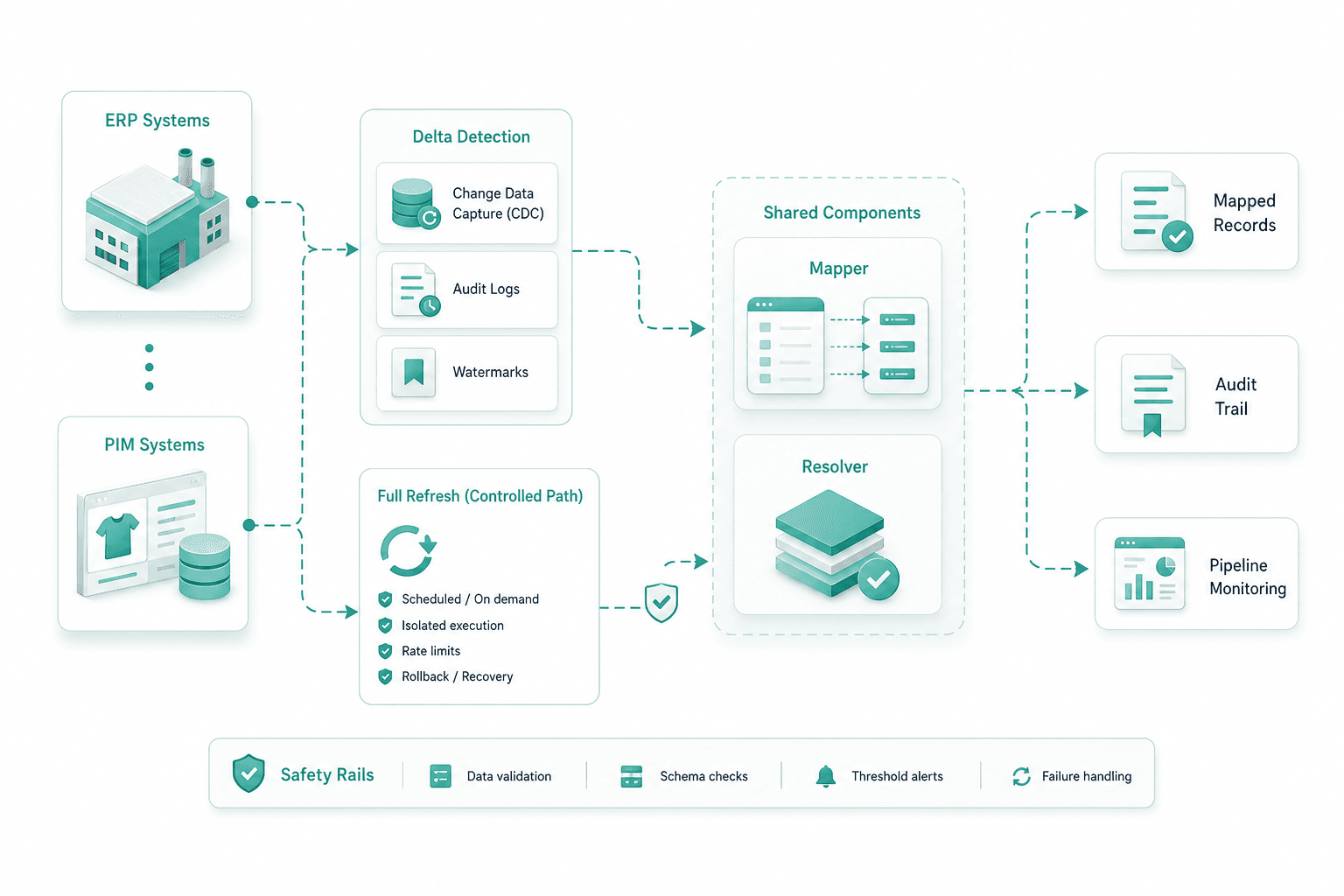
Day-to-day traffic is delta-based: change-data-capture or timestamp watermarks pull only what moved since the last successful run. Full refresh is a controlled scheduled operation — used for taxonomy reshuffles, schema migrations or recovery after a long outage. Both paths share the same mapper and conflict rules; only the scope differs.
Observability surface for ops
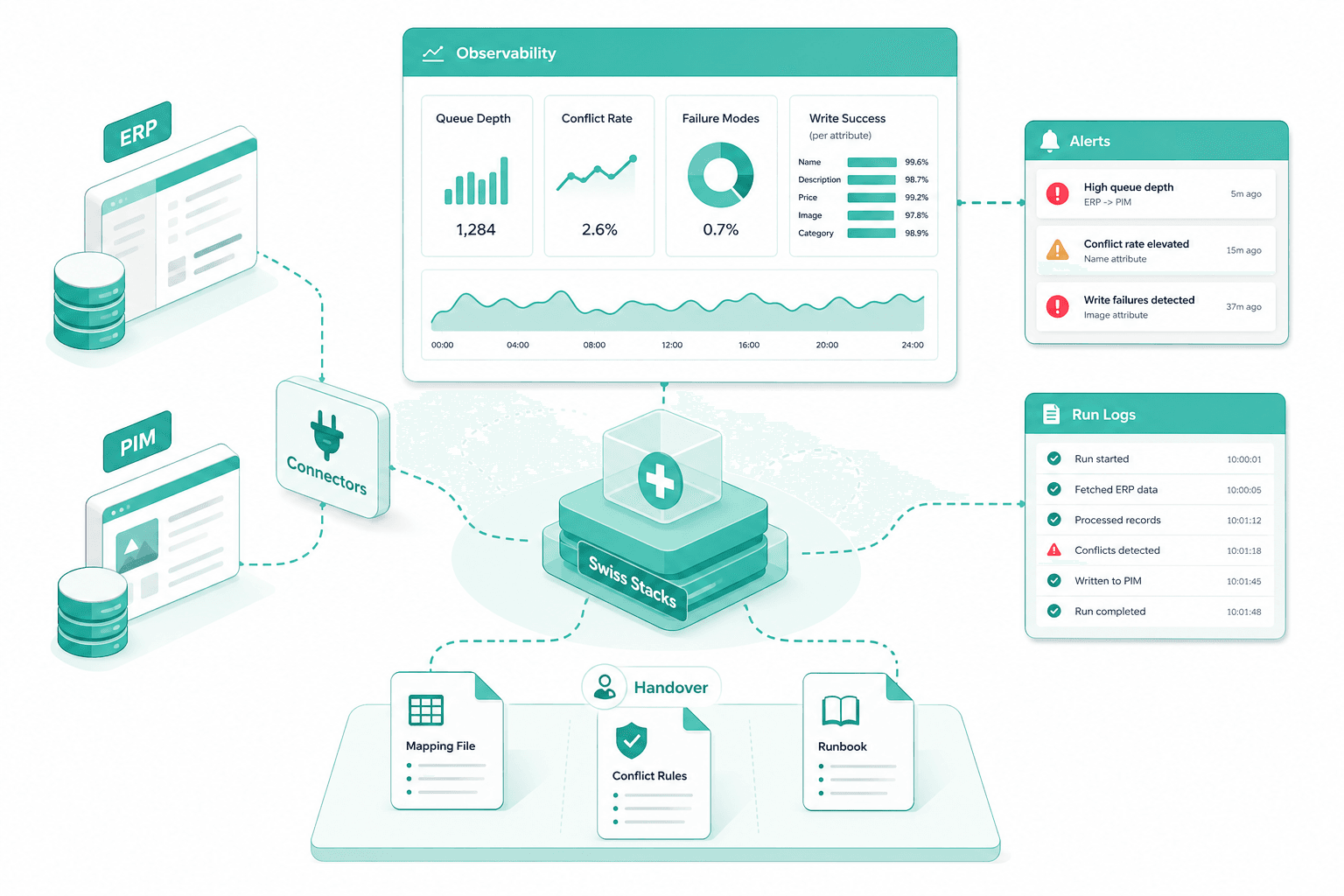
Every sync run exposes which SKUs moved, which attributes changed, which conflicts the resolver handled and which were escalated. Failure states are explicit and named, not silent retries. Operations sees the queue, the lag, the conflict rate and per-attribute write success without asking an engineer to open a log file.
Supported ERP and PIM stacks
We integrate against Akeneo, Contentserv, SAP S/4HANA, Abacus, Dynamics 365 and custom PIM or ERP systems exposing a REST, SOAP, OData or database interface. We are not a vendor partner of any platform — we work against the documented API surface, which keeps the mapping under your control and the connector portable.
How we build it
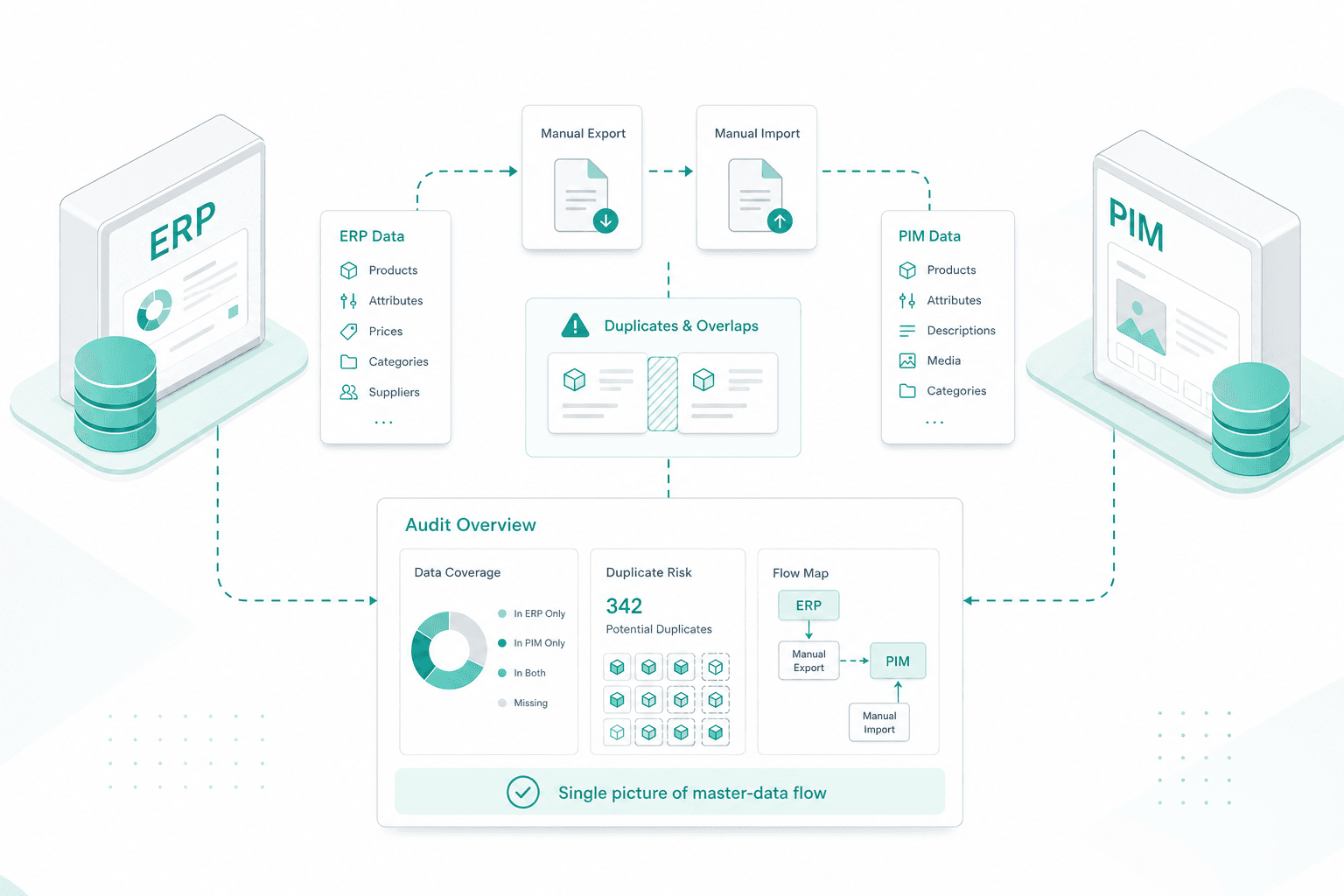
Audit systems and flows
We map what the ERP knows, what the PIM enriches, where duplicates sit and where today's manual exports and imports happen. The audit produces a single picture of the master-data flow before any code is written.
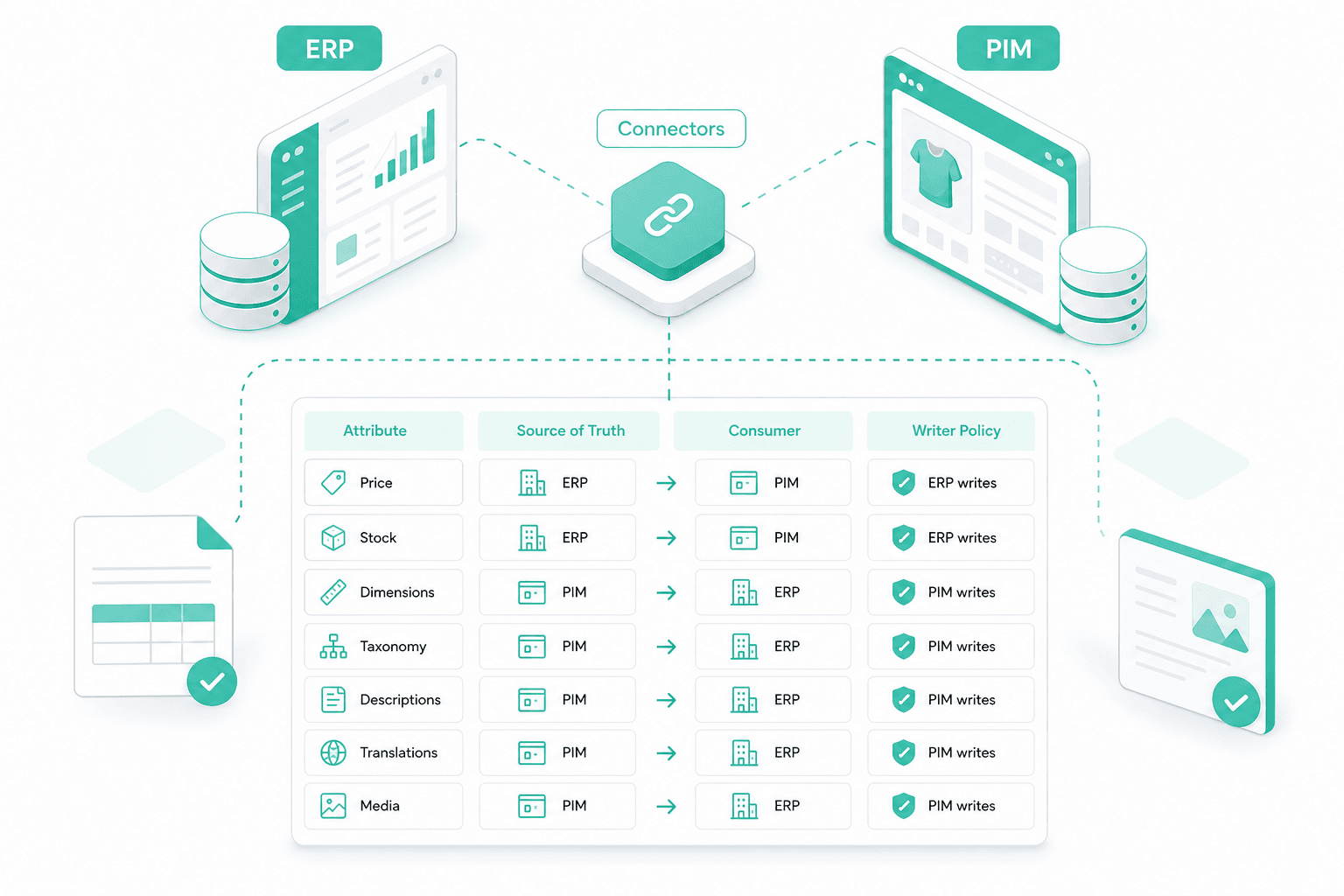
Define ownership model
Attribute by attribute, we declare which side is the source of truth and which side is the consumer. Price, stock, dimensions, taxonomy, descriptions, translations and media each get an owner and a writer policy.
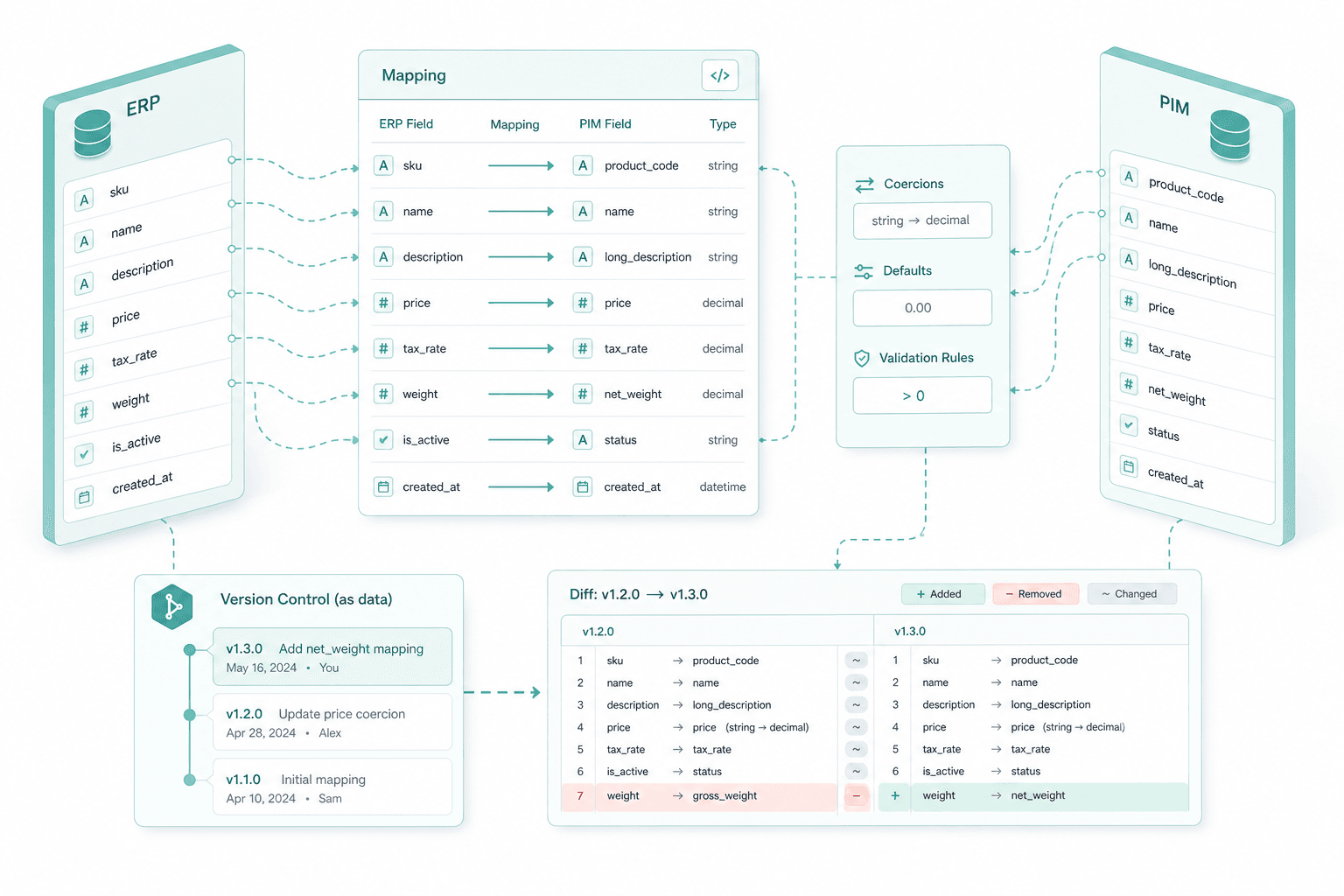
Schema mapping
From the ownership model we draft typed mappings between ERP and PIM fields, with coercions, defaults and validation rules. Mappings live in version control as data; reviewers see a diff of attribute behaviour.
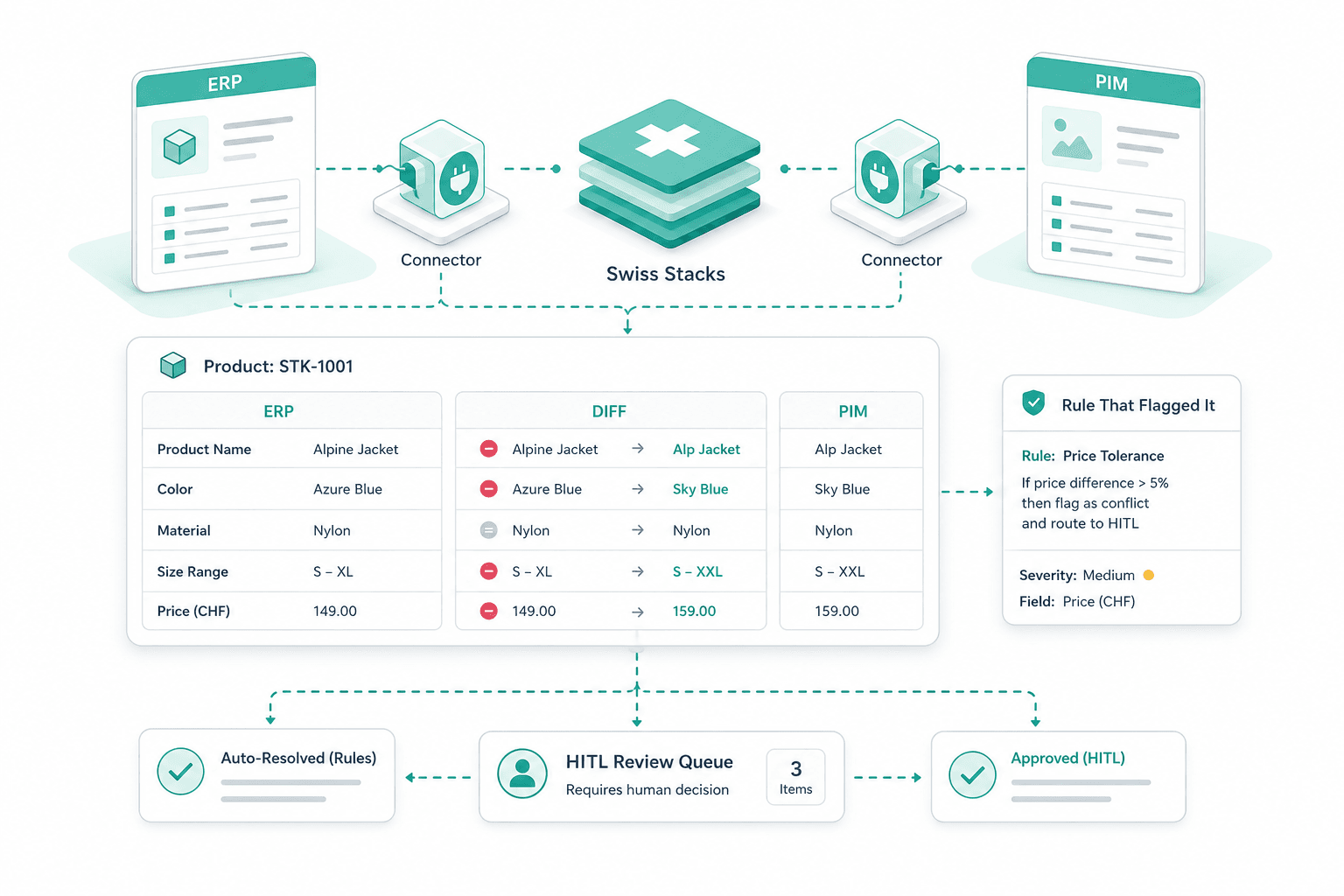
Conflict rules and HITL
We codify the resolver: deterministic rules for common conflicts, explicit HITL routing for cases that need a human decision. The surface shows both sides, the diff and the rule that flagged it — no raw-payload reconstruction.
Delta pipeline build-out
Delta detection is wired against change-data-capture, audit logs or watermarks, depending on the source systems. Full refresh is added as a separate controlled path with safety rails. Both share the mapper and resolver.
Observability, handover
We deliver dashboards, alerts and run logs showing queue depth, conflict rate, failure modes and per-attribute write success. On handover your team owns the mapping file, the conflict rules and the runbook.
We map what the ERP knows, what the PIM enriches, where duplicates sit and where today's manual exports and imports happen. The audit produces a single picture of the master-data flow before any code is written.
Attribute by attribute, we declare which side is the source of truth and which side is the consumer. Price, stock, dimensions, taxonomy, descriptions, translations and media each get an owner and a writer policy.
From the ownership model we draft typed mappings between ERP and PIM fields, with coercions, defaults and validation rules. Mappings live in version control as data; reviewers see a diff of attribute behaviour.
We codify the resolver: deterministic rules for common conflicts, explicit HITL routing for cases that need a human decision. The surface shows both sides, the diff and the rule that flagged it — no raw-payload reconstruction.
Delta detection is wired against change-data-capture, audit logs or watermarks, depending on the source systems. Full refresh is added as a separate controlled path with safety rails. Both share the mapper and resolver.
We deliver dashboards, alerts and run logs showing queue depth, conflict rate, failure modes and per-attribute write success. On handover your team owns the mapping file, the conflict rules and the runbook.
Selected engagements
SANITAS TROESCH
PIM Implementation with HITL AI for Sanitas Troesch

How SAPIENTROQ delivered a PIM implementation with a multi-agent HITL pipeline that ingests 200k+ supplier SKUs from PDFs, Excel and Jira into the Sanitas Troesch PIM with audit-grade governance.
View Case
WEITA AG
Weita Supplier Onboarding Workflow: Wholesale Digital Transformation
How SAPIENTROQ built a Laravel and Next.js workflow that turns PDFs, emails, images and spreadsheets into compliant PIM products for Weita AG, with Mistral OCR, OpenAI JSON-mode extraction and a database-backed prompt registry.
View Case
Why connector projects fail
Connectors are a typed contract layer, not middleware
Middleware moves bytes; a connector enforces meaning. Every attribute crossing ERP↔PIM carries a declared type, an owner and a coercion rule, and the mapping file is the contract reviewers read in version control. The connector refuses a value that breaks the contract instead of writing it through and asking ops to clean up later. That is what keeps integrations boring after month four.
Schema and prompt-rule versions stay in sync across stacks
Akeneo, Contentserv, SAP S/4HANA, Abacus and Dynamics each evolve on their own cadence. We pin schema versions, mapping rules and any AI-side prompt or validation rules to a single tagged release, so a category rename on the PIM side and a pricing-table change on the ERP side never silently overwrite each other. Rollbacks point at one tag, not at three half-deployed branches.
Role-scoped review queues for buyer, category manager and admin
When the resolver cannot decide, the case lands in a HITL queue scoped to the person who can actually decide it. Buyers see price and stock disputes, category managers see taxonomy and description conflicts, admins see structural and access cases. Each queue shows both sides, the diff and the rule that flagged it, and every decision is logged against the mapping version that produced the conflict.
Explicit state-machine lifecycle with named failure states
Each SKU update walks a typed lifecycle: queued, mapped, validated, pushed, reconciled — with named failure states like mapping-mismatch, validation-rejected, push-conflict and reconcile-drift. Ops sees where work is stuck and why, not just that a queue is long. Pair with Master Data Cleansing for the quality layer that feeds clean records into this lifecycle.
Frequently Asked Questions
Off-the-shelf connectors give you a wire between two systems. They fall short on typed attribute mappings, declared ownership per attribute and conflict resolution when both sides change the same SKU. The contract for who owns what is what we build for your business.
All of them, but as a typed mapping per attribute, not a bulk dump. Price and stock typically flow ERP→PIM, descriptions and media flow PIM→ERP, translations move with the PIM side, campaigns can route through either. The direction is part of the ownership model.
The resolver applies a declared rule, not a last-writer-wins heuristic. If ERP owns price, the ERP value wins on price even if PIM was written more recently. Cases that no rule covers route to a HITL queue; the decision is logged against the mapping version.
Deltas run continuously or on a short cadence, pulling only changes since the last successful watermark. Full refresh is scheduled or on-demand, used for taxonomy migrations, schema changes or recovery after a long outage. Both share the mapper and resolver.
SAP S/4HANA, Abacus, Dynamics 365 and custom ERPs on the ERP side; Akeneo, Contentserv and custom PIMs on the PIM side. We integrate against the documented API surface — REST, SOAP, OData or, where unavoidable, a database interface. The mapping stays under your control.
The connector is independent of either side's lifecycle. If the ERP is mid-modernization, see Legacy Modernization — the connector targets old and new surfaces in parallel. For a fresh PIM, Catalog Migration & Onboarding is the inbound side.
About SAPIENTROQ


Interested in a solution?
We are glad to show you various options without any obligation.

Roland Kurmann
CEO, SAPIENTROQ

